Policy For Record Retention
1. Introduction
The International Institute of Technology (IIT) recognizes that effective records management is fundamental to the smooth functioning and long-term sustainability of the institution. As an organization engaged in academic, administrative, and research activities, IIT generates and receives a wide range of records in both physical and digital formats. These records serve as valuable assets that document institutional decisions, support operational processes, ensure compliance with applicable laws and regulations, and preserve the institutional memory of the organization.
A well-defined Record Retention Policy is essential to ensure that such records are managed systematically throughout their lifecycle—from creation and active use to storage and eventual disposal. Proper records management enhances efficiency by enabling quick access to relevant information, reducing duplication, and minimizing storage costs. It also plays a critical role in safeguarding sensitive information, supporting audits, and demonstrating accountability and transparency in institutional operations.
This Record Retention Policy establishes a comprehensive framework that outlines the principles, guidelines, and procedures governing the creation, classification, maintenance, storage, retrieval, and disposal of records at IIT. The policy applies to all departments, faculties, administrative units, and personnel within the institution, including employees, researchers, and authorized third parties who handle institutional records.
The primary objective of this policy is to ensure that records are retained for appropriate durations in alignment with legal, regulatory, academic, financial, and operational requirements. Different categories of records have varying levels of importance and legal obligations; therefore, retention periods must be carefully defined and consistently followed. By adhering to these standards, IIT can mitigate risks associated with premature destruction or unnecessary accumulation of records.
In addition to retention, the policy emphasizes the importance of secure and systematic disposal of records once their retention period has expired. Records that are no longer required must be disposed of in a manner that protects confidentiality, prevents unauthorized access, and complies with applicable data protection and privacy regulations. This includes the secure destruction of physical documents and the permanent deletion of electronic data.
Furthermore, this policy supports the adoption of best practices in records management, including the use of digital systems for efficient storage and retrieval, proper indexing and classification, and regular audits to ensure compliance. It encourages departments to maintain accurate and up-to-date records while promoting a culture of responsibility and awareness among staff regarding the importance of records management.
By implementing this Record Retention Policy, IIT aims to achieve several key outcomes: improved operational efficiency, reduced legal and compliance risks, enhanced information security, and preservation of critical institutional knowledge. The policy also ensures that the institution is well-prepared to respond to information requests, audits, and legal inquiries in a timely and organized manner.
2. Purpose
The purpose of this policy is to:
- Ensure compliance with applicable laws and regulations
- Promote efficient use of storage resources
- Protect sensitive and confidential information
- Facilitate timely retrieval of records
- Establish accountability for record management practices
- Reduce legal risks associated with improper record retention or destruction
3. Scope
This policy applies to all departments, faculties, administrative units, research centers, and affiliated entities of IIT. It covers all forms of records, regardless of format, including but not limited to:
- Physical documents
- Electronic files
- Emails
- Audio and video recordings
- Databases and information systems
4. Definitions
For the purpose of this Record Retention Policy of the International Institute of Technology (IIT), the following key terms are defined to ensure clarity, consistency, and uniform understanding across all departments and personnel involved in the creation, management, storage, and disposal of institutional records.
Record:
A record refers to any information, data, or documentation created, received, or maintained by IIT in the course of its academic, administrative, financial, operational, or research activities. Records may exist in various formats, including but not limited to paper documents, electronic files, emails, databases, photographs, audio recordings, and digital communications. Records serve as evidence of decisions, actions, transactions, and institutional functions. They are essential for supporting accountability, transparency, compliance with legal and regulatory requirements, and the effective functioning of the institution. Examples of records include student enrollment forms, examination results, financial statements, research reports, meeting minutes, official correspondence, and policy documents.
Retention Period:
The retention period is defined as the specified duration for which a record must be maintained and preserved by IIT before it becomes eligible for review, archival, or disposal. The retention period is determined based on legal requirements, regulatory obligations, institutional policies, academic needs, financial auditing standards, and administrative value. Different categories of records may have varying retention periods depending on their importance and relevance. For example, financial records may need to be retained for a minimum number of years as required by law, while academic records may be retained for longer periods due to their long-term reference value. The retention period ensures that records are available when needed for operational use, audits, legal proceedings, or historical reference.
Archival Records:
Archival records are those records that possess enduring historical, legal, administrative, or research value and are therefore preserved permanently or for an extended period beyond their standard retention cycle. These records are no longer required for day-to-day operational purposes but are maintained for their long-term significance. Archival records contribute to preserving the institutional memory of IIT and may be used for research, reference, policy development, and historical documentation. Such records are typically transferred to a designated archival storage system or institutional archive, where they are preserved under controlled conditions to ensure their integrity, authenticity, and accessibility over time. Examples may include foundational institutional documents, significant policy decisions, major research outputs, and records of landmark events.
Confidential Records:
Confidential records are records that contain sensitive, restricted, or private information that must be protected from unauthorized access, disclosure, or misuse. These records may include personal data of students and staff, financial information, examination materials, research data under embargo, legal documents, and internal communications. Access to confidential records is strictly controlled and limited to authorized personnel based on their roles and responsibilities. IIT is responsible for ensuring that appropriate security measures are implemented to safeguard confidential records, including physical security controls, password protection, encryption, access restrictions, and secure disposal methods. Unauthorized access or disclosure of confidential records may result in disciplinary action and legal consequences, depending on the severity of the breach.
5. Policy Statement

IIT is committed to maintaining accurate and complete records and ensuring that records are retained only as long as necessary to meet legal, operational, and academic requirements. Records must be managed in a way that ensures their authenticity, reliability, integrity, and usability.
6. Roles and Responsibilities
6.1 Governing Body
The governing body of IIT is responsible for approving this policy and ensuring oversight of its implementation.
6.2 Records Management Committee
A Records Management Committee (RMC) shall be established to:
- Develop and update retention schedules
- Monitor compliance
- Provide guidance and training
6.3 Department Heads
Department heads are responsible for:
- Implementing the policy within their units
- Ensuring proper record classification and storage
- Authorizing record disposal
6.4 Employees and Faculty
All staff and faculty must:
- Create and maintain accurate records
- Follow retention schedules
- Protect confidential information
7. Record Classification
Records shall be classified into the following categories:
7.1 Academic Records
- Student admissions records
- Academic transcripts
- Examination records
7.2 Administrative Records
- Financial documents
- HR records
- Procurement records
7.3 Research Records
- Research data
- Grant documentation
- Ethics approvals
7.4 Legal Records
- Contracts
- Litigation files
- Compliance documents
8. Retention Schedule
A retention schedule shall be maintained and periodically updated. The following are general guidelines:
8.1 Permanent Records
- Governing body minutes
- Accreditation documents
- Final academic transcripts
8.2 Long-Term Retention (10+ years)
- Financial statements
- Employee records
- Research data (as required)
8.3 Medium-Term Retention (5–10 years)
- Internal reports
- Correspondence
8.4 Short-Term Retention (1–5 years)
- Routine administrative records
- Draft documents
9. Storage and Security
9.1 Physical Records
- Stored in secure, access-controlled environments
- Protected from environmental damage
9.2 Electronic Records
- Stored on secure servers with regular backups
- Access controlled via authentication mechanisms
9.3 Confidentiality
- Sensitive records must be encrypted or securely locked
- Access restricted to authorized personnel only
10. Record Disposal
Records must be disposed of in a secure and environmentally responsible manner once their retention period has expired.
10.1 Disposal Methods
- Shredding for physical documents
- Secure deletion for electronic records
10.2 Authorization
- Disposal must be approved by department heads and documented
11. Legal Holds
A legal hold refers to a formal process initiated by the International Institute of Technology (IIT) to preserve specific records that may be relevant to actual, pending, or reasonably anticipated litigation, audits, investigations, regulatory inquiries, or other legal proceedings. The purpose of a legal hold is to ensure that all potentially relevant information is retained intact and is not altered, deleted, destroyed, or disposed of, even if such records have reached or exceeded their standard retention period as defined in this policy.
The issuance of a legal hold takes precedence over the routine record retention and disposal schedule. Once a legal hold notice has been communicated, all normal destruction processes for the identified records must be immediately suspended. This applies to both physical and electronic records, including documents, emails, databases, reports, correspondence, drafts, backups, and any other form of recorded information that may be relevant to the matter under review.
Legal holds are typically initiated by the designated legal authority within IIT, such as the Legal Department, Compliance Office, or any authorized institutional officer acting on legal advice. The legal hold notice will clearly identify the scope of the records to be preserved, the departments or individuals responsible for maintaining them, and any specific instructions regarding storage, handling, or access restrictions. The scope may be broad or narrowly defined depending on the nature of the legal matter and the potential relevance of the records involved.
Upon receipt of a legal hold notice, all employees, departments, and record custodians are required to comply immediately and fully. It is the responsibility of each individual or unit holding relevant records to ensure that appropriate preservation measures are implemented. This may include disabling automatic deletion functions, securing physical files in controlled storage, preserving digital backups, and ensuring that no modifications are made to the records in question.
The obligation to preserve records under legal hold remains in effect until an official notice of release is issued by the authorized legal authority. Only after such notification is received may the affected records be returned to their normal retention schedule and processed for disposal if applicable. Premature destruction or alteration of records under legal hold, whether intentional or accidental, may result in serious consequences, including disciplinary action against responsible individuals and potential legal liability for the institution.
To ensure effective compliance, IIT may maintain a centralized tracking system for all active legal holds. This system helps monitor the status of preserved records, ensures accountability, and facilitates timely communication between departments. Regular training and awareness programs may also be conducted to ensure that staff members understand their obligations regarding legal holds and the importance of strict adherence to preservation requirements.
Legal holds are a critical component of IIT’s overall records management and compliance framework. They protect the institution’s legal interests, ensure the integrity of evidence, and demonstrate good faith in legal and regulatory processes. By implementing and adhering to legal hold procedures, IIT reinforces its commitment to lawful conduct, risk management, and institutional accountability.
12. Compliance and Audit
Compliance with the Record Retention Policy is mandatory for all departments, faculties, administrative units, employees, and any authorized individuals handling institutional records at the International Institute of Technology (IIT). This section establishes the framework for monitoring adherence to the policy and ensuring that record management practices are consistently implemented in accordance with defined standards, legal requirements, and institutional expectations.
To ensure effective compliance, IIT shall conduct regular audits of its record management systems and practices. These audits may be scheduled periodically or conducted on an ad hoc basis, depending on institutional requirements, risk assessments, or external regulatory obligations. The primary objective of these audits is to verify that records are being properly created, classified, stored, retained, and disposed of in accordance with the guidelines outlined in this policy. Audits also help identify gaps, inefficiencies, or deviations from established procedures and provide recommendations for corrective action.
The audit process may include a review of both physical and electronic records, examination of retention schedules, evaluation of storage systems, and assessment of security controls protecting sensitive and confidential information. Additionally, auditors may verify whether legal holds are being properly implemented and whether records scheduled for disposal are being destroyed securely and in a timely manner. Departments may be required to provide documentation, access to records, and cooperation during audit activities to facilitate a comprehensive review.
Responsibility for conducting audits may rest with an internal audit team, compliance office, or other designated authority within IIT. In some cases, external auditors may also be engaged to ensure independent evaluation and to strengthen transparency and accountability. The findings of these audits will be documented in formal reports, which will be submitted to relevant institutional authorities for review and action.
In the event that non-compliance with the Record Retention Policy is identified, IIT will take appropriate corrective and preventive measures. Non-compliance may include, but is not limited to, failure to retain records for the required period, unauthorized destruction of records, improper handling of confidential information, or failure to comply with legal hold requirements. Depending on the severity and nature of the violation, corrective actions may include mandatory training, process improvements, system updates, or disciplinary measures.
Disciplinary action for non-compliance may be imposed in accordance with IIT’s internal rules, human resource policies, and applicable legal frameworks. Such actions may range from formal warnings to suspension, termination of employment, or legal proceedings in cases involving serious breaches or intentional misconduct. The institution treats record management compliance as a critical responsibility, and violations are addressed with appropriate seriousness to protect institutional integrity and legal standing.
Furthermore, IIT is committed to fostering a culture of accountability and continuous improvement in records management practices. Findings from audits will be used not only to address deficiencies but also to enhance systems, update procedures, and improve staff awareness. Regular training programs and communication initiatives may be conducted to ensure that all stakeholders understand their responsibilities under this policy.
13. Training and Awareness
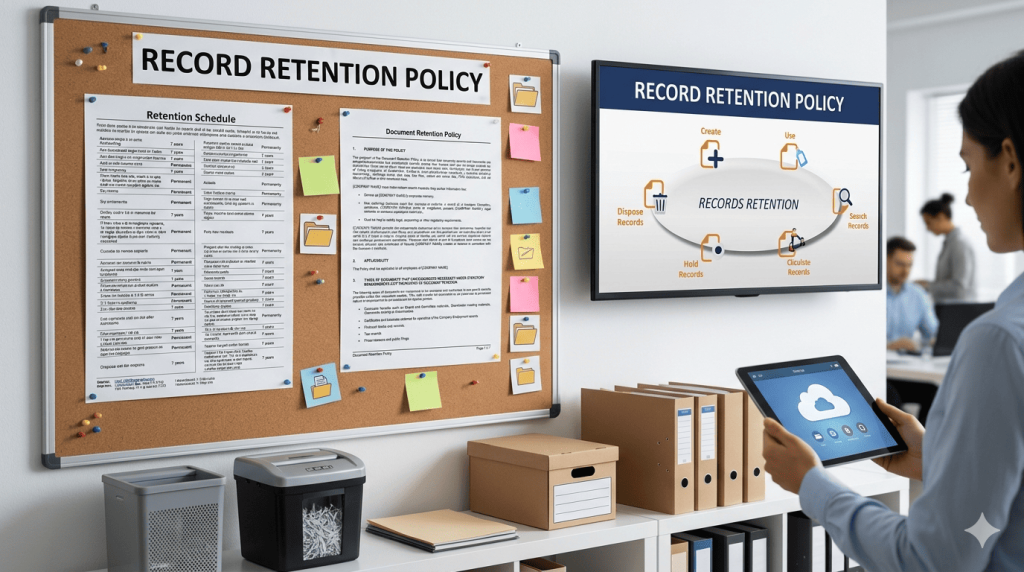
The International Institute of Technology (IIT) recognizes that the effectiveness of any Record Retention Policy depends not only on clearly defined procedures and systems but also on the awareness, understanding, and active participation of all employees involved in record creation and management. Accordingly, IIT is committed to implementing structured training and awareness programs to ensure that all staff members, faculty, researchers, and administrative personnel fully understand their responsibilities under this policy.
Training programs shall be designed to provide comprehensive guidance on the principles and practices of records management, including the creation, classification, storage, retention, retrieval, protection, and disposal of records. These programs will also cover the importance of maintaining accurate and complete records, adhering to retention schedules, and ensuring compliance with legal, regulatory, and institutional requirements. Special emphasis will be placed on handling confidential records, data privacy obligations, and the proper procedures for managing records subject to legal holds.
The training initiatives may be conducted in various formats, including induction training for new employees, periodic refresher courses, workshops, seminars, webinars, and department-specific training sessions. Induction training will ensure that all newly appointed staff members are introduced to IIT’s records management policies at the beginning of their employment. Refresher training sessions will be conducted periodically to update employees on any changes in policies, procedures, or legal requirements, and to reinforce good practices.
In addition to formal training sessions, IIT shall promote ongoing awareness through internal communication channels such as emails, newsletters, policy manuals, intranet portals, and informational materials. These resources will serve to continuously reinforce key messages related to record management and ensure that employees remain informed about their responsibilities on an ongoing basis.
Departments and administrative units may also be required to designate record management coordinators or officers who will act as points of contact for guidance and support. These individuals will assist in implementing the policy at the departmental level, provide clarification on retention schedules, and help resolve practical issues related to record handling and compliance.
The effectiveness of training programs will be regularly evaluated to ensure that they meet institutional needs and regulatory expectations. Feedback from participants may be collected to improve the quality and relevance of training content. Additionally, IIT may conduct assessments or evaluations to measure employee understanding and identify areas where further training is required.
Awareness of record management responsibilities is essential not only for compliance but also for promoting a culture of accountability, transparency, and efficiency within the institution. When employees understand the value of proper record keeping, they are better equipped to contribute to effective governance and risk management. This, in turn, supports the institution’s broader goals of operational excellence and institutional integrity.
Failure to participate in mandatory training programs or to adhere to established record management practices may result in corrective action, as outlined in the institution’s disciplinary policies. Therefore, all employees are expected to take training obligations seriously and apply the knowledge gained in their daily work activities.
14. Policy Review
The Record Retention Policy of the International Institute of Technology (IIT) is a dynamic framework designed to support effective records management in alignment with evolving legal, regulatory, technological, and institutional requirements. To ensure that the policy remains relevant, practical, and fully compliant with applicable standards, a formal review process shall be undertaken at regular intervals.
This policy shall be reviewed at least once every three years. The three-year review cycle is established to ensure that the policy continues to reflect current best practices in records management, changes in applicable laws and regulations, advancements in information technology, and the operational needs of the institution. However, IIT also reserves the right to initiate an earlier review of the policy if circumstances require it. Such circumstances may include significant changes in legal or regulatory frameworks, organizational restructuring, introduction of new digital record-keeping systems, or identification of compliance gaps during audits or operational assessments.
The review process shall be conducted under the supervision of a designated authority within IIT, such as the Records Management Committee, Compliance Office, or any other appointed governing body responsible for policy oversight. This authority will be responsible for coordinating input from relevant stakeholders, including academic departments, administrative units, IT services, legal advisors, and internal audit teams. The collaborative nature of the review process ensures that all functional areas of the institution are adequately represented and that the policy reflects practical operational realities.
As part of the review process, existing provisions of the policy will be evaluated to determine their effectiveness, clarity, and applicability. This includes assessing whether current retention schedules remain appropriate, whether classification systems are functioning efficiently, and whether procedures for record storage, access, and disposal are being implemented effectively. Special attention will be given to emerging challenges such as digital data management, cybersecurity risks, data protection requirements, and compliance with privacy regulations.
Feedback from audits, training sessions, and operational experience will also be considered during the review. This ensures that any identified issues, inefficiencies, or gaps in implementation are addressed in a timely manner. Where necessary, amendments will be proposed to update or refine policy provisions to enhance clarity, improve compliance, or introduce new practices that align with technological or regulatory developments.
Once the review is completed, proposed revisions shall be documented and submitted for approval to the appropriate institutional authority, such as senior management or the governing board of IIT. Upon approval, the updated policy shall be formally communicated to all relevant stakeholders across the institution. Adequate dissemination and awareness measures shall be undertaken to ensure that all employees are informed of any changes and understand their updated responsibilities.
Until such revisions are approved and implemented, the existing policy shall remain in full force and effect. All departments and personnel are required to continue complying with the current provisions of the policy during the review period.
15. Conclusion
Effective record retention is a fundamental component of sound institutional governance and plays a vital role in ensuring the long-term success, accountability, and operational integrity of the International Institute of Technology (IIT). As an academic and research-oriented institution, IIT generates and manages a vast and continuously growing volume of records across its academic, administrative, financial, and research functions. The proper management of these records is not merely an administrative requirement but a strategic necessity that supports transparency, informed decision-making, and institutional continuity.
By adhering to this Record Retention Policy, IIT reinforces its commitment to maintaining high standards of compliance with applicable legal, regulatory, and statutory requirements. Proper record retention ensures that essential information is available when required for audits, inspections, legal proceedings, academic reviews, and internal assessments. It also helps safeguard the institution against potential risks arising from the loss, misuse, or unauthorized disclosure of important information. In this way, the policy acts as a protective framework that reduces legal and operational vulnerabilities.
In addition to compliance, effective record retention significantly enhances operational efficiency. When records are systematically created, categorized, stored, and retrieved, institutional processes become more streamlined and less time-consuming. Staff and administrators can access accurate and up-to-date information quickly, thereby improving productivity and reducing duplication of effort. A well-structured records management system also minimizes storage costs and eliminates unnecessary accumulation of outdated or redundant documents, both in physical and digital formats.
Furthermore, this policy promotes accountability and transparency across all levels of IIT’s operations. Records serve as objective evidence of institutional actions, decisions, and transactions. When properly maintained, they provide a clear audit trail that supports ethical governance and responsible administration. This transparency strengthens trust among stakeholders, including students, faculty, regulatory bodies, funding agencies, and the wider academic community.
The policy also plays a crucial role in preserving institutional memory. Over time, records capture the evolution of policies, academic programs, research achievements, and administrative developments. Archiving significant records ensures that valuable historical and intellectual resources are preserved for future reference, research, and institutional learning. This continuity of knowledge supports strategic planning and helps the institution build upon its past achievements.
Table of Contents