Consultancy
Consultancy plays a vital role in today’s dynamic and competitive environment, where organizations, institutions, and individuals constantly seek expert guidance to improve performance, solve complex problems, and achieve sustainable growth. At its core, consultancy is about delivering specialized knowledge, strategic insights, and practical solutions tailored to the unique needs of a client. Whether it is in the fields of education, business, technology, quality management, or organizational development, consultancy services help bridge the gap between current challenges and desired outcomes.
In an increasingly globalized world, where change is rapid and often unpredictable, the value of experienced consultants has grown significantly, as they bring not only technical expertise but also an external perspective that enables clients to identify opportunities and mitigate risks more effectively.
One of the key strengths of consultancy lies in its ability to offer customized solutions rather than one-size-fits-all approaches. Every organization operates within its own context, shaped by its culture, resources, goals, and challenges. Consultants begin by thoroughly analyzing the client’s situation, conducting assessments, and identifying gaps in processes, systems, or strategies. This diagnostic phase is crucial, as it lays the foundation for developing targeted recommendations that align with the client’s objectives. Whether it involves improving operational efficiency, implementing quality standards, enhancing academic programs, or optimizing business processes, consultancy services are designed to deliver measurable results and long-term value.
In the academic and training sectors, consultancy has become particularly important as institutions strive to meet evolving industry demands and maintain high standards of education. Academic consultancy services assist institutions in curriculum design, accreditation processes, faculty development, research enhancement, and institutional governance. By leveraging industry insights and best practices, consultants help educational institutions align their programs with global standards, ensuring that students are equipped with relevant skills and knowledge. This not only enhances the reputation of the institution but also improves employability outcomes for graduates. Furthermore, consultancy in training and development supports organizations in building a skilled workforce through structured learning programs, competency mapping, and performance improvement initiatives.
Business consultancy, on the other hand, focuses on helping organizations improve their overall performance and competitiveness. This may include strategic planning, market analysis, financial management, risk assessment, and process optimization. Consultants work closely with leadership teams to identify growth opportunities, streamline operations, and implement effective strategies. In many cases, businesses seek consultancy services during periods of transition, such as expansion, restructuring, or digital transformation. The objective is to ensure that changes are implemented smoothly and that the organization remains resilient in the face of challenges. By providing data-driven insights and practical recommendations, consultants enable businesses to make informed decisions and achieve sustainable growth.
Another important aspect of consultancy is its role in quality assurance and compliance. In industries where standards and regulations are critical, such as manufacturing, healthcare, and certification bodies, consultancy services help organizations meet compliance requirements and maintain high levels of quality. This may involve implementing international standards, conducting audits, developing documentation systems, and training staff on best practices. Quality consultancy not only ensures compliance but also fosters a culture of continuous improvement, where organizations are committed to enhancing their processes and delivering excellence in their products or services.
Technology consultancy has also gained prominence in recent years, driven by the rapid advancement of digital technologies. Organizations are increasingly relying on consultants to guide them through digital transformation initiatives, including the adoption of new technologies, system integration, cybersecurity, and data management. Technology consultants help organizations leverage innovation to improve efficiency, enhance customer experiences, and stay competitive in a digital-first world. Their expertise ensures that technology investments are aligned with business goals and deliver maximum return on investment.
ACADEMIC DIVISIONS: A COMPREHENSIVE OVERVIEW
Academic divisions form the intellectual backbone of any leading institution, shaping its identity, research priorities, and educational excellence. These divisions are not merely administrative structures; they represent dynamic ecosystems where knowledge is created, refined, and disseminated. From engineering and sciences to humanities, management, and interdisciplinary centers, each academic division contributes uniquely to the holistic development of students and the advancement of society.
This detailed exploration of academic divisions highlights the breadth and depth of disciplines offered, reflecting a commitment to innovation, research excellence, and real-world impact.
ENGINEERING AND TECHNOLOGY DIVISIONS
Aerospace Engineering
Aerospace Engineering focuses on the design, development, and testing of aircraft, spacecraft, and related systems. This division integrates aerodynamics, propulsion, avionics, and structural analysis to address challenges in aviation and space exploration. Students gain hands-on experience through simulations, laboratory work, and collaborative projects, preparing them for careers in defense, aviation, and space research organizations.
Civil Engineering
Civil Engineering deals with the planning, design, construction, and maintenance of infrastructure such as buildings, bridges, roads, and water systems. This division emphasizes sustainability, smart cities, and resilient infrastructure. Students are trained to solve real-world problems related to urban development and environmental challenges.
Computer Science & Engineering
Computer Science & Engineering is at the forefront of technological innovation. It encompasses artificial intelligence, machine learning, cybersecurity, data science, and software development. This division equips students with computational thinking and problem-solving skills essential for the digital era.
Electrical Engineering
Electrical Engineering focuses on electrical systems, electronics, power generation, and communication technologies. The division plays a crucial role in advancing renewable energy systems, smart grids, and electronic devices, preparing students for cutting-edge industries.
Mechanical Engineering
Mechanical Engineering covers the design, analysis, and manufacturing of mechanical systems. From robotics and automation to thermal systems and manufacturing processes, this division offers diverse opportunities for innovation and research.
Metallurgical Engineering & Materials Science
This division studies the properties, processing, and applications of metals and materials. It plays a vital role in industries such as manufacturing, aerospace, and nanotechnology by developing advanced materials with enhanced performance.
Chemical Engineering
Chemical Engineering integrates chemistry, physics, and biology to design processes for producing chemicals, pharmaceuticals, and energy. The division emphasizes sustainable processes, green technologies, and industrial applications.
SCIENCE DIVISIONS
Chemistry
The Chemistry division explores the composition, structure, and properties of matter. It supports research in organic, inorganic, physical, and analytical chemistry, contributing to advancements in pharmaceuticals, materials science, and environmental solutions.
Physics
Physics provides fundamental insights into the laws governing the universe. The division focuses on areas such as quantum mechanics, astrophysics, condensed matter, and nuclear physics, fostering innovation in both theoretical and applied sciences.
Mathematics
Mathematics serves as the foundation for all scientific and engineering disciplines. This division emphasizes pure and applied mathematics, including algebra, calculus, statistics, and computational mathematics, enabling students to tackle complex problems across domains.
Earth Sciences
Earth Sciences examines the physical structure and processes of the Earth. This division addresses issues such as climate change, natural resource management, and geophysical exploration, playing a critical role in environmental sustainability.
INTERDISCIPLINARY AND EMERGING FIELDS

Biosciences and Bioengineering
This division bridges biology and engineering to develop solutions in healthcare, biotechnology, and environmental sustainability. It includes research in genetics, biomedical devices, and bioinformatics.
Energy Science and Engineering
Energy Science focuses on sustainable energy solutions, including renewable energy, energy storage, and efficiency. The division is central to addressing global energy challenges and climate change.
Environmental Science and Engineering (ESED)
ESED combines environmental science with engineering principles to develop solutions for pollution control, waste management, and sustainable development.
Climate Studies
Climate Studies addresses the science of climate systems, global warming, and environmental impact. It integrates data analysis, modeling, and policy research to tackle one of the most pressing global challenges.
Systems and Control Engineering
This division focuses on the modeling and control of dynamic systems, with applications in robotics, automation, aerospace, and industrial processes.
MANAGEMENT AND ENTREPRENEURSHIP
Shailesh J. Mehta School of Management (SJMSoM)
SJMSoM offers management education with a strong focus on leadership, strategy, and innovation. It integrates technical knowledge with business acumen, preparing students for leadership roles in global organizations.
Desai Sethi School of Entrepreneurship (DSSE)
DSSE fosters entrepreneurial thinking and innovation. It provides students with the skills and resources to create startups, develop business models, and drive economic growth.
Industrial Engineering & Operations Research (IEOR)
This division focuses on optimizing complex systems and processes. It combines engineering, mathematics, and management principles to improve efficiency and decision-making in industries.
HUMANITIES, SOCIAL SCIENCES, AND POLICY
Humanities & Social Sciences
This division enriches technical education by incorporating disciplines such as sociology, psychology, philosophy, and communication. It fosters critical thinking, ethical reasoning, and cultural awareness.
Economics
Economics examines the production, distribution, and consumption of resources. The division emphasizes quantitative analysis and policy-making, contributing to economic development and financial systems.
Centre for Liberal Education (CLE)
CLE promotes interdisciplinary learning and holistic education. It encourages students to explore diverse subjects beyond their core disciplines, fostering creativity and critical thinking.
Ashank Desai Centre for Policy Studies (ADCPS)
ADCPS focuses on public policy research and analysis. It bridges academia and governance, addressing societal challenges through evidence-based policy solutions.
DESIGN, INNOVATION, AND DIGITAL TRANSFORMATION
IDC School of Design (IDC SoD)
IDC SoD emphasizes human-centered design, innovation, and creativity. It integrates technology, aesthetics, and user experience to develop impactful design solutions.
Educational Technology
This division focuses on the integration of technology in education. It develops digital learning tools, online platforms, and innovative teaching methodologies.
Centre for Machine Intelligence and Data Science (C-MinDS)
C-MinDS is dedicated to artificial intelligence, data analytics, and machine learning. It drives research in intelligent systems and data-driven decision-making.
SPECIALIZED RESEARCH CENTRES
Centre of Studies in Resources Engineering (CSRE)
CSRE focuses on resource management, including water, minerals, and energy. It supports sustainable development through advanced research and technology.
Centre for Technology Alternatives for Rural Areas (CTARA)
CTARA works on rural development and sustainable technologies. It aims to improve the quality of life in rural communities through innovative solutions.
Koita Centre for Digital Health (KCDH)
KCDH integrates healthcare and technology, focusing on digital health solutions, telemedicine, and healthcare analytics.
Centre for Research in Nanotechnology and Science (CRNTS)
CRNTS advances research in nanotechnology, enabling breakthroughs in materials, electronics, medicine, and energy applications.
DUPLICATE AND REINFORCED DIVISIONS
Industrial Engineering and Operations Research (IEOR)
The presence of IEOR in multiple listings highlights its importance in modern academia. It plays a crucial role in optimizing systems, improving efficiency, and supporting data-driven decision-making across industries.
THE ROLE OF ACADEMIC DIVISIONS IN MODERN EDUCATION
Academic divisions are more than just subject categories; they are innovation hubs that:
- Foster interdisciplinary collaboration
- Encourage research and development
- Address global challenges such as climate change, healthcare, and sustainability
- Prepare students for dynamic and evolving career landscapes
These divisions work collectively to create an ecosystem where knowledge is not confined to classrooms but extends to laboratories, industries, and communities.
CONCLUSION
The diversity of academic divisions reflects a commitment to excellence, innovation, and societal impact. From traditional disciplines like Physics and Mathematics to emerging fields like Machine Intelligence and Climate Studies, each division contributes to a comprehensive educational framework.
By integrating engineering, science, humanities, management, and specialized research centers, these academic divisions create a balanced and future-ready learning environment. They empower students to become leaders, innovators, and problem-solvers capable of addressing complex global challenges.
CENTRES PROVIDING RESEARCH AND SUPPORT FACILITIES: A COMPREHENSIVE OVERVIEW
Centres providing research and support facilities are the driving force behind innovation, technological advancement, and real-world problem-solving in modern academic ecosystems. These centres act as bridges between theoretical knowledge and practical application, enabling collaboration among academia, industry, and government bodies. They are designed to foster interdisciplinary research, encourage entrepreneurship, and develop solutions to global challenges such as energy sustainability, healthcare innovation, water management, and national security.
The following detailed exploration highlights the significance, objectives, and impact of various specialized centres that contribute to research excellence and societal development.
ADVANCED TECHNOLOGY AND ENGINEERING RESEARCH CENTRES
Centre for Semiconductor Technologies (SemiX)
The Centre for Semiconductor Technologies (SemiX) focuses on the development and advancement of semiconductor devices and systems. Semiconductors form the backbone of modern electronics, powering everything from smartphones and computers to advanced defense systems and space technologies. This centre emphasizes research in chip design, fabrication processes, nanoelectronics, and integrated circuits.
SemiX plays a critical role in strengthening domestic capabilities in semiconductor manufacturing, reducing dependence on imports, and supporting national initiatives in electronics and digital infrastructure. It also provides students and researchers with access to cleanroom facilities, fabrication labs, and advanced simulation tools.
Centre of Excellence in Steel Technology (CoEST)
The Centre of Excellence in Steel Technology (CoEST) is dedicated to advancing metallurgical processes and improving steel production technologies. Steel remains one of the most widely used materials in construction, infrastructure, and manufacturing industries.
This centre focuses on improving material strength, durability, and sustainability through innovative research. Areas of interest include advanced alloy development, corrosion resistance, and energy-efficient production techniques. Collaboration with industry partners ensures that research outcomes are aligned with real-world industrial needs.
Centre of Excellence in Oil, Gas and Energy (CoE-OGE)
The Centre of Excellence in Oil, Gas and Energy (CoE-OGE) addresses challenges in the energy sector, particularly in fossil fuels and energy transition. It focuses on exploration technologies, refining processes, and energy optimization.
With the global shift toward cleaner energy, the centre also explores hybrid energy systems, carbon capture technologies, and sustainable energy solutions. It plays a vital role in balancing traditional energy demands with environmental responsibility.
DRDO-Industry-Academia Centre of Excellence (DIA-CoE)
The DRDO-Industry-Academia Centre of Excellence (DIA-CoE) represents a strategic collaboration between defense organizations, academic institutions, and industry stakeholders. Its primary objective is to develop advanced technologies for national defense and security.
Research areas include autonomous systems, advanced materials, cybersecurity, and defense electronics. The centre fosters innovation by providing a platform where theoretical research meets practical defense applications, ensuring technological self-reliance.
NATIONAL SECURITY AND STRATEGIC TECHNOLOGY CENTRES

National Centre of Excellence in Technology for Internal Security (NCETIS)
NCETIS focuses on developing technologies that enhance internal security and public safety. This includes surveillance systems, threat detection technologies, cybersecurity frameworks, and disaster management solutions.
The centre collaborates with government agencies and law enforcement organizations to design tools that improve response times, intelligence gathering, and risk mitigation. It plays a crucial role in ensuring national stability and resilience.
ENERGY AND SUSTAINABILITY RESEARCH CENTRES
National Centre for Photovoltaic Research and Education (NCPRE)
NCPRE is dedicated to solar energy research, particularly photovoltaic (PV) technologies. It aims to improve the efficiency, affordability, and scalability of solar power systems.
The centre conducts research on solar cell materials, energy storage solutions, and grid integration. It also provides training and educational programs to promote the adoption of renewable energy technologies, contributing to a sustainable energy future.
Centre of Excellence on Membrane Technologies for Desalination, Brine Management, and Water Recycling
This centre focuses on addressing global water scarcity through advanced membrane technologies. It works on desalination processes, wastewater treatment, and recycling systems.
Research includes the development of high-efficiency membranes, energy-saving desalination techniques, and sustainable water management practices. The centre plays a vital role in ensuring access to clean water, particularly in water-stressed regions.
Water Innovation Centre: Technology, Research and Education (WICTRE)
WICTRE is dedicated to water resource management and innovation. It integrates technology, research, and education to develop solutions for water conservation, distribution, and quality monitoring.
The centre focuses on smart water systems, groundwater management, and climate-resilient water strategies. It also engages in community outreach programs to promote sustainable water practices.
HEALTHCARE, BIOENGINEERING, AND LIFE SCIENCES
Biomedical Engineering and Technology Incubation Centre (BETiC)
BETiC serves as a hub for medical innovation and healthcare technology development. It supports the creation of affordable medical devices, diagnostic tools, and healthcare solutions tailored to local and global needs.
The centre fosters collaboration between engineers, doctors, and entrepreneurs, enabling the rapid translation of ideas into market-ready products. It also provides incubation support for startups in the healthcare sector.
Wadhwani Research Centre for Bioengineering (WRCB)
WRCB focuses on cutting-edge research in bioengineering, including tissue engineering, medical imaging, and regenerative medicine. The centre aims to develop technologies that improve healthcare outcomes and enhance quality of life.
Its interdisciplinary approach combines biology, engineering, and medicine to address complex health challenges, from chronic diseases to advanced diagnostics.
Sunita Sanghi Centre of Ageing and Neurodegenerative Diseases (SCAN)
SCAN is dedicated to understanding and addressing ageing-related conditions and neurodegenerative diseases such as Alzheimer’s and Parkinson’s. The centre conducts research on disease mechanisms, early diagnosis, and therapeutic interventions.
It also explores the social and psychological aspects of ageing, contributing to holistic healthcare solutions for the elderly population.
ARTIFICIAL INTELLIGENCE AND DIGITAL INNOVATION
Technocraft Centre for Applied Artificial Intelligence (TCAAI)
TCAAI focuses on the application of artificial intelligence across various sectors, including healthcare, finance, manufacturing, and smart cities. It develops AI-driven solutions for data analysis, automation, and decision-making.
The centre emphasizes practical implementation, ensuring that AI technologies are accessible, scalable, and impactful in real-world scenarios.
Centre of Excellence in Quantum Information, Computing, Science and Technology (CoE-QuICST)
CoE-QuICST explores the emerging field of quantum computing and quantum information science. This centre focuses on developing quantum algorithms, communication systems, and cryptographic techniques.
Quantum technologies have the potential to revolutionize computing, offering unprecedented processing power and security. The centre plays a key role in positioning research institutions at the forefront of this technological revolution.
DESIGN, INNOVATION, AND SOCIAL IMPACT
Tata Centre for Technology and Design (TCTD)
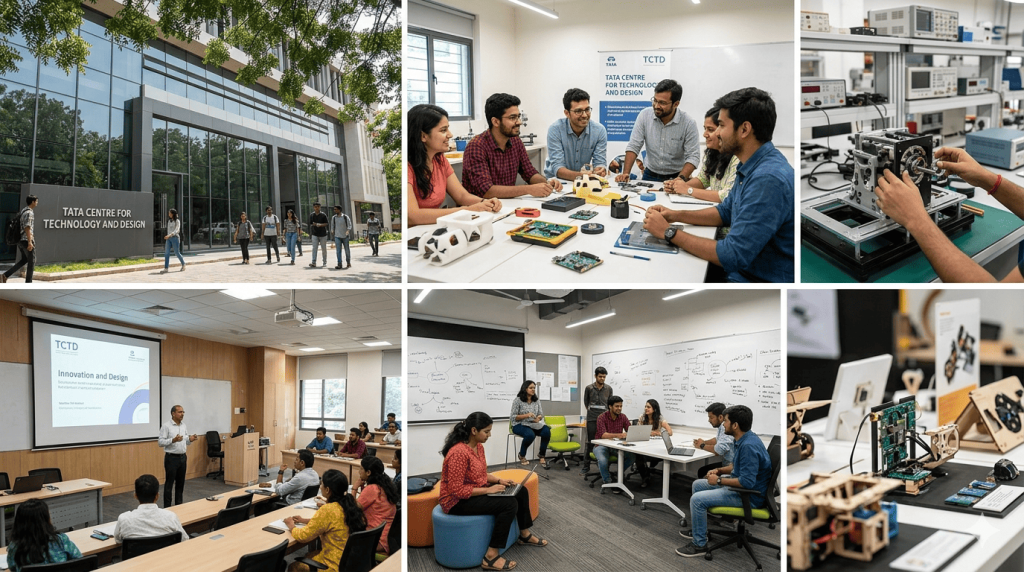
TCTD focuses on developing innovative solutions for societal challenges, particularly in underserved communities. It emphasizes affordable, scalable, and sustainable technologies in areas such as healthcare, energy, water, and agriculture.
The centre encourages students and researchers to work on real-world problems, fostering a culture of social responsibility and impact-driven innovation.
Wadhwani Research Centre for Bioengineering (WRCB) (Reinforced Importance)
The repeated emphasis on WRCB highlights its central role in advancing bioengineering research and healthcare innovation. Its contributions extend beyond academia, influencing industry practices and public health policies.
INTERDISCIPLINARY AND COLLABORATIVE IMPACT
These research and support centres collectively create a vibrant ecosystem of innovation by:
- Encouraging interdisciplinary collaboration
- Bridging the gap between academia and industry
- Supporting startups and entrepreneurship
- Addressing national and global challenges
- Enhancing research infrastructure and capabilities
They provide access to advanced laboratories, funding opportunities, mentorship programs, and industry partnerships, enabling researchers to push the boundaries of knowledge.
THE ROLE OF RESEARCH CENTRES IN NATIONAL DEVELOPMENT
Research centres play a crucial role in national development by:
- Driving technological self-reliance
- Supporting policy-making and governance
- Promoting sustainable development
- Enhancing global competitiveness
- Creating employment and economic growth
Their contributions are particularly significant in emerging economies, where innovation is key to addressing developmental challenges.
FUTURE DIRECTIONS AND OPPORTUNITIES
As the world faces complex challenges such as climate change, healthcare crises, and technological disruption, research centres will continue to evolve. Future directions include:
- Integration of AI and data analytics across all domains
- Development of sustainable and green technologies
- Expansion of interdisciplinary research initiatives
- Strengthening global collaborations
- Focus on inclusive and equitable innovation
These centres will play a pivotal role in shaping the future by fostering creativity, critical thinking, and problem-solving skills.
CONCLUSION
Centres providing research and support facilities are essential pillars of modern academic and innovation ecosystems. They go beyond traditional education by creating environments where ideas are transformed into impactful solutions.
From semiconductor technologies and quantum computing to healthcare innovation and water management, these centres address some of the most pressing challenges of our time. Their interdisciplinary nature, combined with strong industry and government collaboration, ensures that research is not only academically rigorous but also socially relevant.
Table of Contents