Academic Scheduling
A Comprehensive Study with Reference to the International Institute of Technology (IIT)
1. Introduction
Academic scheduling is one of the most critical administrative processes in any educational institution. It ensures that courses, faculty, classrooms, and students are efficiently coordinated within a defined academic calendar. In modern higher education systems, such as those followed by institutions like the International Institute of Technology (IIT), academic scheduling is not merely about creating timetables; it is a strategic function that directly impacts teaching effectiveness, resource utilization, and student success.
The increasing complexity of higher education—characterized by multidisciplinary programs, diverse student needs, and technological integration—has made academic scheduling a sophisticated and dynamic process. Institutions must balance multiple constraints, including faculty availability, classroom capacity, course demand, and institutional policies.
This paper explores the concept, processes, challenges, tools, and best practices of academic scheduling, with a contextual application to IIT.
2. Concept of Academic Scheduling
Academic scheduling refers to the systematic planning and allocation of:
- Courses and subjects
- Faculty members
- Classrooms and facilities
- Time slots within an academic term
It ensures that all academic activities occur without conflicts and align with institutional goals.
In higher education, scheduling involves answering key questions such as:
- Which courses will be offered?
- How many sections are required?
- Who will teach each course?
- When and where will classes be held?
These decisions are typically made collaboratively between academic departments and administrative units.
3. Importance of Academic Scheduling
Academic scheduling plays a crucial role in institutional efficiency and student success. Its importance can be understood through the following aspects:
3.1 Efficient Resource Utilization
Proper scheduling ensures optimal use of classrooms, laboratories, and faculty time. Without efficient scheduling, resources may remain underutilized or overburdened.
3.2 Improved Student Experience
A well-designed schedule minimizes course conflicts, allowing students to enroll in required subjects without delays in graduation.
3.3 Faculty Workload Management
Scheduling helps balance teaching loads, ensuring fairness and preventing burnout among faculty members.
3.4 Institutional Productivity
Efficient scheduling enhances operational efficiency and supports long-term planning.
3.5 Conflict Reduction
Modern scheduling systems aim to eliminate clashes such as:
- Double-booked classrooms
- Overlapping courses
- Faculty scheduling conflicts
4. Academic Scheduling Process
Academic scheduling is a multi-phase process involving coordination across departments. It generally consists of the following stages:
4.1 Academic Planning Phase
This is the initial stage where the framework of the schedule is developed. Key steps include:
- Defining academic terms
- Identifying courses to be offered
- Determining course types (lecture, lab, seminar)
- Assigning instructors
- Setting room preferences
During this phase, institutions often rely on historical data and enrollment trends to make informed decisions.
4.2 Scheduling and Optimization
In this stage:
- Courses are assigned time slots
- Classrooms are allocated
- Conflicts are resolved
- Scheduling algorithms optimize the timetable
Modern systems use data analytics and artificial intelligence to improve efficiency.
4.3 Publishing the Schedule
Once finalized:
- The schedule is published for students and faculty
- Information is integrated into student information systems
4.4 Post-Publishing Adjustments
After publication:
- Changes are made based on feedback
- Conflicts are resolved
- Final exam schedules are created
This two-phase structure—planning and post-publishing—is common in higher education institutions.
5. Components of Academic Scheduling
Academic scheduling involves several interconnected components:
5.1 Courses and Curriculum
Courses form the foundation of scheduling. Each course has attributes such as:
- Credits
- Duration
- Type (lecture/lab)
5.2 Faculty
Faculty availability, expertise, and workload are critical factors.
5.3 Classrooms and Facilities
Rooms must meet requirements such as:
- Seating capacity
- Equipment availability
- Specialized facilities (labs, studios)
5.4 Time Slots
Time slots must be structured to:
- Avoid overlaps
- Maintain consistency
- Accommodate institutional policies
5.5 Students
Student enrollment patterns influence scheduling decisions.
6. Challenges in Academic Scheduling
Academic scheduling is inherently complex due to multiple constraints and variables.
6.1 Complexity of Constraints
Institutions must consider:
- Faculty availability
- Room capacity
- Course prerequisites
- Student preferences
This complexity often makes scheduling comparable to solving a “multi-variable optimization problem.”
6.2 Large Scale Operations
Universities may manage:
- Thousands of students
- Hundreds of faculty
- Multiple campuses
This scale increases the difficulty of scheduling.
6.3 Dynamic Changes
Last-minute changes such as:
- Faculty unavailability
- Course cancellations
- Room maintenance
require flexible scheduling systems.
6.4 Manual Errors
Traditional scheduling methods using spreadsheets often lead to errors and inefficiencies.
6.5 Resource Constraints
Limited classrooms or faculty can create bottlenecks.
7. Role of Technology in Academic Scheduling
Modern academic scheduling relies heavily on technology.
7.1 Scheduling Software
Specialized software systems help institutions:
- Automate scheduling
- Reduce conflicts
- Improve accuracy
Examples include:
- Timetable management systems
- Student information systems (SIS)
- AI-based scheduling tools
7.2 Features of Modern Scheduling Systems
Modern systems offer:
- Real-time updates
- Centralized calendars
- Conflict detection
- Faculty workload tracking
- Data analytics
These systems eliminate reliance on manual processes and improve efficiency.
7.3 Artificial Intelligence and Optimization
AI-based scheduling tools can:
- Analyze enrollment trends
- Predict course demand
- Optimize room allocation
- Balance faculty workloads
They generate conflict-free schedules while maximizing resource utilization.
8. Academic Scheduling at International Institute of Technology (IIT)

Although specific operational details may vary, institutions like IIT typically follow structured scheduling practices aligned with global standards.
8.1 Institutional Context
The International Institute of Technology emphasizes:
- Technical education
- Structured academic programs
- Efficient resource management
8.2 Scheduling Framework at IIT
A typical scheduling framework at IIT includes:
8.2.1 Academic Calendar
Defines:
- Semester duration
- Examination periods
- Holidays
8.2.2 Course Planning
Departments decide:
- Courses offered
- Number of sections
- Faculty assignments
8.2.3 Timetable Development
Timetables are created considering:
- Course requirements
- Faculty availability
- Classroom capacity
8.2.4 Technology Integration
IIT likely uses digital tools to:
- Manage schedules
- Communicate updates
- Maintain transparency
8.3 Benefits for IIT
Effective scheduling enables IIT to:
- Deliver high-quality education
- Ensure smooth academic operations
- Enhance student satisfaction
9. Best Practices in Academic Scheduling
Institutions can improve scheduling through the following best practices:
9.1 Data-Driven Decision Making
Use historical data to:
- Predict enrollment
- Optimize course offerings
9.2 Centralized Scheduling Systems
Implement centralized platforms to:
- Improve coordination
- Reduce duplication
9.3 Collaboration Across Departments
Ensure communication between:
- Academic departments
- Administration
9.4 Flexibility
Allow for adjustments to accommodate:
- Changes in demand
- Unexpected disruptions
9.5 Continuous Evaluation
Regularly review scheduling outcomes to identify improvements.
10. Impact of Academic Scheduling on Students
Academic scheduling directly influences student outcomes.
10.1 Course Availability
Proper scheduling ensures students can enroll in required courses.
10.2 Academic Progression
Reduces delays in graduation.
10.3 Learning Experience
Balanced schedules improve learning efficiency.
10.4 Student Satisfaction
Conflict-free schedules enhance overall satisfaction.
11. Future Trends in Academic Scheduling
Academic scheduling is evolving with technological advancements.
11.1 AI and Machine Learning
Future systems will:
- Predict student demand
- Automate decision-making
11.2 Cloud-Based Solutions
Cloud platforms enable:
- Remote access
- Real-time updates
11.3 Personalized Scheduling
Students may receive customized schedules based on preferences.
11.4 Integration with Smart Campuses
Scheduling systems will integrate with:
- IoT devices
- Smart classrooms
12. Case Insights from Modern Scheduling Systems
Modern scheduling systems have significantly transformed how educational institutions and organizations manage academic planning and resource allocation. Unlike traditional manual scheduling methods, which relied heavily on spreadsheets and human coordination, modern digital scheduling platforms use automation, analytics, and optimization algorithms to streamline the entire process. The case insights from these systems highlight major improvements in efficiency, accuracy, and institutional performance.
One of the most notable outcomes of modern scheduling platforms is the reduction in scheduling time. In traditional systems, timetable preparation could take several weeks due to manual data entry, conflict checking, and repeated revisions. However, modern scheduling software automates these processes by analyzing course requirements, faculty availability, and classroom constraints simultaneously. As a result, what once took weeks can now be completed in hours or even minutes. Institutions such as universities and technical institutes benefit from faster academic planning cycles, allowing them to focus more on teaching quality and student engagement rather than administrative delays.
Another major improvement is enhanced accuracy. Manual scheduling is prone to errors such as overlapping classes, double-booked rooms, or incorrect faculty assignments. Modern systems eliminate many of these issues by using rule-based algorithms and artificial intelligence to detect and resolve conflicts automatically. These systems ensure that no two classes are scheduled in the same room at the same time and that faculty workloads are distributed fairly. This level of precision reduces administrative stress and improves the overall reliability of academic operations.
Modern scheduling systems also contribute to better resource utilization. Classrooms, laboratories, and faculty time are valuable institutional resources, and inefficient scheduling can lead to underuse or overuse. Advanced scheduling tools analyze historical data and real-time constraints to allocate resources more effectively. For example, large lecture halls can be assigned to high-enrollment courses, while smaller rooms are allocated to seminars or tutorials. This optimization ensures maximum utilization of infrastructure while minimizing idle capacity.
Beyond operational efficiency, modern systems provide institutions with powerful tools to analyze performance. Scheduling software often includes dashboards and reporting features that allow administrators to track key metrics such as classroom occupancy rates, faculty workload distribution, and student enrollment trends. These insights help institutions identify inefficiencies and make data-driven decisions for future academic planning. For instance, if certain time slots consistently show low attendance, administrators can adjust scheduling patterns accordingly.
In addition, modern scheduling systems enable institutions to optimize operations at a strategic level. By using predictive analytics, these systems can forecast course demand, identify peak resource usage periods, and suggest optimal scheduling patterns. This proactive approach allows institutions to plan ahead rather than react to problems after they occur. It also supports long-term academic planning, including curriculum development and faculty recruitment.
Finally, these systems play a crucial role in enhancing student outcomes. A well-structured schedule ensures that students can attend all required courses without conflicts, reducing academic stress and improving learning continuity. It also allows for better time management, enabling students to balance academic and extracurricular activities effectively. When scheduling is efficient and transparent, student satisfaction and academic performance tend to improve significantly.
In conclusion, case insights from modern scheduling systems demonstrate a clear shift from manual administrative processes to intelligent, data-driven solutions. By reducing scheduling time, improving accuracy, optimizing resource utilization, enabling performance analysis, and enhancing student outcomes, these systems have become an essential component of modern educational institutions.
13. Conclusion
Academic scheduling is a fundamental component of higher education management. It ensures the effective coordination of courses, faculty, classrooms, and students, contributing to institutional efficiency and student success.
In institutions like the International Institute of Technology (IIT), academic scheduling plays a strategic role in delivering quality education. With the integration of modern technologies such as AI and data analytics, scheduling has evolved from a manual administrative task to a sophisticated, data-driven process.
As higher education continues to grow in complexity, the importance of efficient academic scheduling will only increase. Institutions that adopt innovative scheduling practices and technologies will be better positioned to meet the challenges of the future and provide enhanced learning experiences.
14. References
- Academic Scheduling Process – Boston University
- Ad Astra Scheduling Software Overview
- EMS Academic Planning Guide
- TimetableMaster Scheduling Overview
- Virtosoftware Student Scheduling Guide
Calendar and Timetable
1. Introduction
The academic calendar and timetable are two foundational components of academic scheduling in higher education institutions. They serve as structured frameworks that guide all academic activities throughout the year. While the academic calendar provides a macro-level overview of the academic year, the timetable offers a micro-level, day-to-day execution plan of teaching and learning activities.
Institutions such as the International Institute of Technology (IIT) rely on well-designed calendars and timetables to ensure smooth academic operations, efficient use of resources, and enhanced student learning experiences.
2. Academic Calendar
2.1 Definition
An academic calendar is an official document that outlines the key dates and events of an academic year. It serves as a roadmap for students, faculty, and administrators, helping them plan their activities in advance.
2.2 Components of an Academic Calendar
A typical academic calendar includes:
- Start and End Dates of Semesters
- Registration Periods
- Add/Drop Deadlines
- Examination Schedules
- Holidays and Breaks
- Assignment and Project Deadlines
- Graduation Dates
2.3 Types of Academic Calendars
Different institutions follow different academic calendar systems:
2.3.1 Semester System
- Academic year divided into two main semesters
- Common in engineering and technical institutes like IIT
2.3.2 Trimester System
- Academic year divided into three terms
- Faster-paced learning
2.3.3 Quarter System
- Four terms per year
- Offers flexibility and more course options
2.4 Importance of Academic Calendar
The academic calendar plays a vital role in institutional functioning:
- Planning Tool: Helps in long-term planning
- Coordination: Aligns activities across departments
- Time Management: Ensures deadlines are met
- Transparency: Provides clarity to students and staff
2.5 Academic Calendar at IIT
At institutions like IIT, the academic calendar is carefully structured to:
- Balance academic rigor with breaks
- Provide sufficient time for exams and evaluations
- Align with national holidays and institutional policies
It ensures that all departments operate in sync and maintain consistency across programs.
3. Timetable
3.1 Definition
A timetable is a detailed schedule that specifies the timing and location of classes, lectures, laboratories, and other academic activities on a daily or weekly basis.
3.2 Components of a Timetable
A standard timetable includes:
- Course Name and Code
- Instructor Name
- Classroom or Lab Location
- Day and Time Slot
- Duration of Each Session
3.3 Types of Timetables
3.3.1 Master Timetable
- Prepared by administration
- Covers all courses and departments
3.3.2 Faculty Timetable
- Individual schedule for instructors
3.3.3 Student Timetable
- Personalized schedule based on enrolled courses
3.4 Principles of Effective Timetable Design
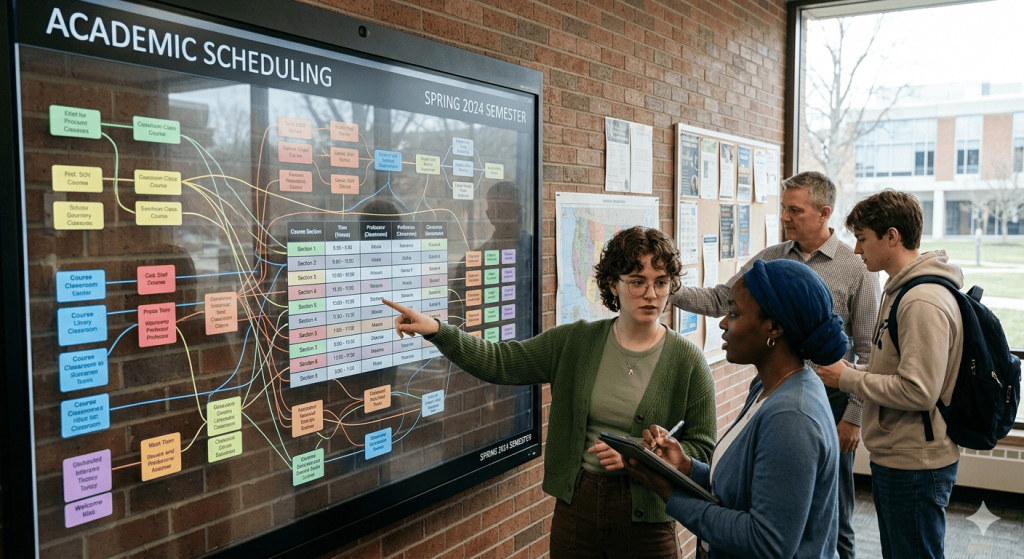
An effective timetable should follow these principles:
- Conflict-Free Scheduling
- Balanced Workload
- Efficient Resource Utilization
- Flexibility
- Consistency
3.5 Timetable Scheduling Process
The timetable preparation process includes:
- Collecting Course Data
- Assigning Faculty
- Allocating Classrooms
- Fixing Time Slots
- Resolving Conflicts
- Final Approval and Publication
3.6 Challenges in Timetable Preparation
Timetable scheduling faces several challenges:
- Overlapping classes
- Limited classroom availability
- Faculty time constraints
- Diverse course requirements
- Last-minute changes
These challenges require systematic planning and often technological support.
3.7 Timetable at IIT
At IIT, timetable creation is typically:
- Centralized: Managed by academic administration
- Technology-Driven: Uses scheduling software
- Optimized: Ensures minimal conflicts
- Transparent: Easily accessible to students and faculty
This ensures efficient coordination across departments and smooth academic delivery.
4. Difference Between Academic Calendar and Timetable
| Aspect | Academic Calendar | Timetable |
|---|---|---|
| Scope | Broad (year/semester) | Detailed (daily/weekly) |
| Purpose | Planning and structure | Execution of classes |
| Users | All stakeholders | Students & faculty |
| Flexibility | Less frequent changes | Can be updated regularly |
5. Relationship Between Calendar and Timetable
The academic calendar and timetable are interdependent:
- The calendar sets the framework (when activities occur)
- The timetable implements the framework (how activities occur)
For example:
- Calendar defines exam week → Timetable schedules exact exam timings
- Calendar defines semester → Timetable allocates daily lectures
6. Role of Technology
Modern institutions, including IIT, use digital tools for:
- Automated timetable generation
- Real-time updates
- Conflict detection
- Mobile access for students
Technology reduces manual errors and improves efficiency.
7. Best Practices
To improve calendar and timetable effectiveness:
- Use data-driven planning
- Ensure stakeholder collaboration
- Maintain flexibility
- Regularly review schedules
- Use advanced scheduling software
Table of Contents