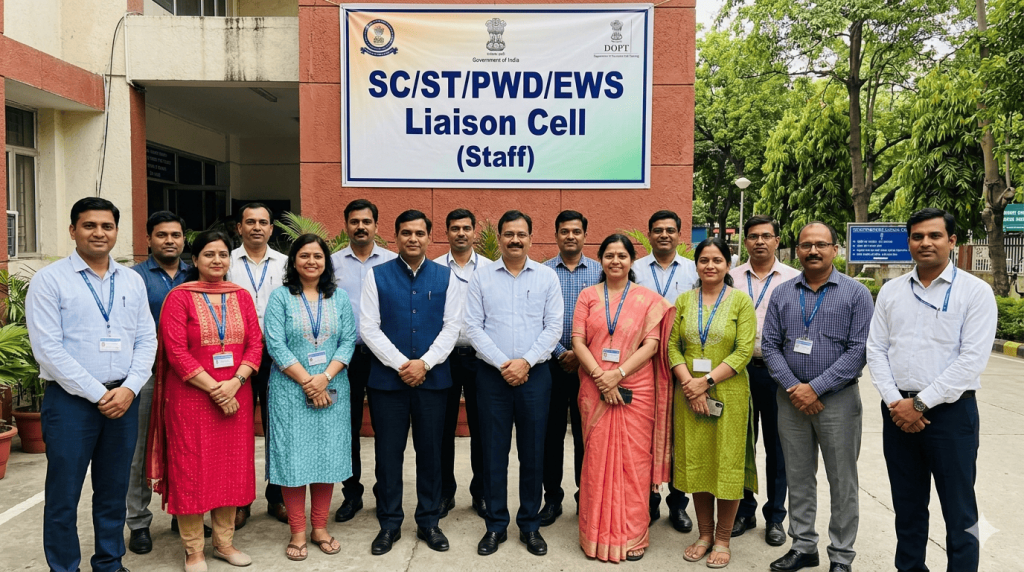
SC/ST/PWD/EWS Liaison Cell (Staff)
A Comprehensive Overview
1. Introduction
Higher education institutions in India, particularly centrally funded technical institutions such as the International Institute of Technology (IIT), function within a robust constitutional and policy-driven framework that prioritizes the principles of equity, inclusion, and social justice. These institutions are not only centers of academic excellence and research but also important instruments for implementing the Government of India’s affirmative action policies in education and employment. Within this framework, institutional mechanisms such as the SC/ST/PWD/EWS Liaison Cell (Staff) play a crucial role in ensuring that constitutional guarantees are effectively translated into administrative practice.
The Indian Constitution provides the foundational basis for such mechanisms through several provisions that promote the advancement of historically disadvantaged groups. Articles 15(4) and 16(4) enable the State to make special provisions for the advancement of Scheduled Castes (SC) and Scheduled Tribes (ST) in matters of education and public employment. Additionally, Article 46 directs the State to promote the educational and economic interests of weaker sections of society and protect them from social injustice and all forms of exploitation. Over time, these provisions have been operationalized through reservation policies and administrative guidelines issued by the Government of India, particularly through the Department of Personnel and Training (DoPT) and the Ministry of Education.
In recent years, the scope of affirmative action has expanded further to include Persons with Disabilities (PWD) under the Rights of Persons with Disabilities Act, 2016, which mandates equal opportunity, non-discrimination, and reasonable accommodation in employment. Similarly, the introduction of the Economically Weaker Sections (EWS) reservation framework through the 103rd Constitutional Amendment reflects the State’s commitment to addressing economic disadvantage alongside social disadvantage. Together, these categories form the basis for structured institutional support systems within government-funded organizations, including IITs.
The SC/ST/PWD/EWS Liaison Cell (Staff) is one such institutional mechanism designed to ensure effective implementation of these policies. It is primarily an administrative and welfare-oriented unit that functions as a bridge between employees belonging to reserved categories and the institute’s administrative structure. The cell ensures that employees from these categories receive fair treatment in recruitment, promotions, service conditions, and workplace interactions. It also ensures that statutory reservation norms are properly implemented and maintained across all levels of staffing.
In practical terms, the Liaison Cell serves multiple interconnected functions. First and foremost, it is responsible for ensuring compliance with reservation policies in all aspects of staff recruitment and promotion. This includes maintaining accurate reservation rosters, verifying vacancy positions, and ensuring that appointments are made in accordance with applicable government rules. In large institutions such as IITs, where administrative and technical staffing structures are complex, this function is critical for maintaining transparency and accountability.
Secondly, the cell plays an important role in monitoring service conditions of employees belonging to SC, ST, PWD, and EWS categories. This includes tracking career progression, identifying potential disparities in promotion opportunities, and ensuring that eligible employees are not overlooked due to systemic or procedural biases. By doing so, the cell contributes to creating a more equitable workplace environment that aligns with constitutional principles.
Another significant responsibility of the Liaison Cell is grievance redressal. Employees from reserved categories may sometimes face issues related to discrimination, lack of opportunity, workplace bias, or administrative delays. The Liaison Cell acts as a formal channel through which such grievances can be reported, reviewed, and addressed. While it may not always function as a quasi-judicial authority, it plays an important facilitative role by coordinating with relevant departments and ensuring that concerns are appropriately escalated and resolved.
The cell also contributes to institutional sensitization and awareness-building. Through workshops, training programs, and orientation sessions, it promotes understanding among staff members regarding reservation policies, inclusivity, and disability rights. This helps foster a more respectful and supportive organizational culture, reducing the likelihood of discrimination and improving overall workplace harmony.
In addition, the Liaison Cell serves as a compliance and reporting unit that interacts with external regulatory bodies such as the Ministry of Education, DoPT, and various National Commissions for SC, ST, and Persons with Disabilities. It prepares periodic reports, participates in audits, and ensures that the institution adheres to statutory requirements. This external accountability mechanism reinforces the importance of accurate documentation and transparent administrative processes.
The establishment of such a cell is particularly significant in IITs, which are often viewed as elite institutions with highly competitive recruitment and promotion structures. While academic excellence remains the primary focus, it is equally important that administrative systems within these institutions reflect the values of social justice and inclusivity. The Liaison Cell ensures that diversity is not merely symbolic but is actively supported through structured governance mechanisms.
2. Constitutional and Policy Background
The establishment of such liaison cells is rooted in several constitutional provisions and government directives:
2.1 Constitutional Provisions
- Article 15(4) & 16(4): Allow special provisions for advancement of SC/ST communities.
- Article 46: Promotes educational and economic interests of weaker sections.
- Rights of Persons with Disabilities Act, 2016: Ensures equal opportunity and non-discrimination for PWD employees.
2.2 Government Directives
- Department of Personnel and Training (DoPT) guidelines
- University Grants Commission (UGC) directives
- Ministry of Education circulars for centrally funded institutions
These frameworks mandate institutions like IITs to establish reservation compliance and grievance redressal mechanisms, which are operationalized through liaison cells.
3. Meaning and Purpose of the Liaison Cell
The SC/ST/PWD/EWS Liaison Cell (Staff) is an institutional administrative unit that acts as a bridge between employees from reserved categories and the institute’s management.
Primary Purpose:
To ensure equal opportunity, fair treatment, and effective implementation of reservation and welfare policies in recruitment, promotion, service conditions, and workplace environment.
4. Composition of the Cell
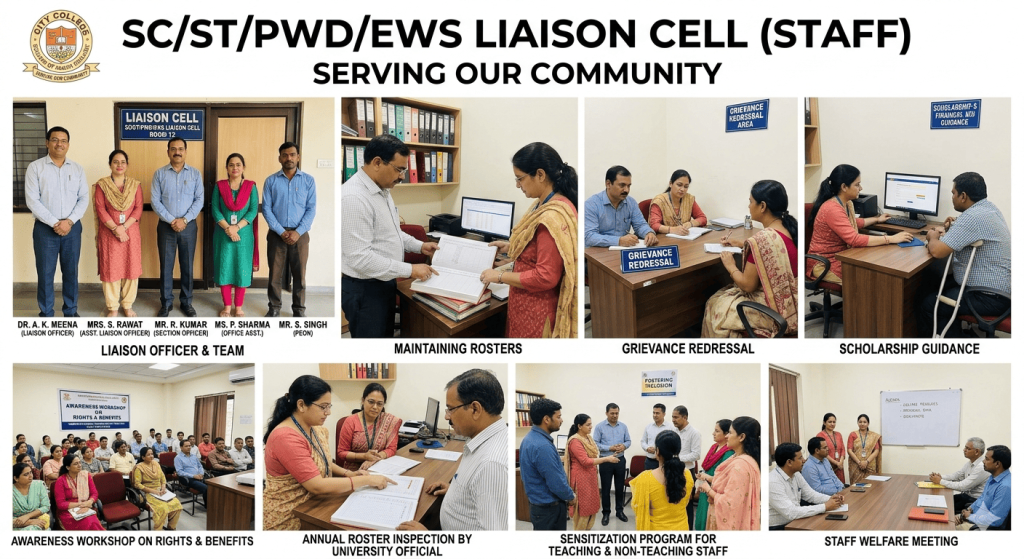
The Liaison Cell is generally composed of:
4.1 Liaison Officer
- A senior administrative or faculty member appointed by the institute
- Responsible for overall coordination and compliance
4.2 Supporting Staff
- Administrative officers
- HR personnel
- Data entry and record management staff
4.3 Advisory Committee (in some IITs)
- Representatives from SC/ST communities
- Legal or compliance officers
- Representatives from administration
The structure ensures both administrative authority and representation of stakeholder interests.
5. Key Functions of the Liaison Cell
The functions of the SC/ST/PWD/EWS Liaison Cell are broad and multi-dimensional.
5.1 Implementation of Reservation Policies
The cell ensures compliance with reservation rules in:
- Recruitment of non-teaching staff
- Promotions and career advancement
- Contractual and permanent appointments
It verifies roster maintenance and reservation quotas as per government norms.
5.2 Maintenance of Reservation Rosters
A crucial responsibility includes maintaining:
- Post-based reservation rosters
- Category-wise employee records
- Vacancy tracking systems
This ensures transparency and legal compliance.
5.3 Grievance Redressal
The cell addresses complaints related to:
- Workplace discrimination
- Harassment or bias
- Promotion delays
- Service-related issues
It acts as a first-level institutional grievance forum.
5.4 Monitoring Promotions and Career Progression
The Liaison Cell ensures that eligible employees from SC/ST/PWD/EWS categories are:
- Considered fairly for promotions
- Provided necessary support for eligibility criteria
- Not excluded due to systemic bias
5.5 Liaison with Government Authorities
The cell coordinates with:
- Ministry of Education
- DoPT
- National Commission for SC/ST
- Department of Empowerment of Persons with Disabilities
This ensures compliance with audits and inspections.
5.6 Awareness and Sensitization
The cell organizes programs such as:
- Diversity and inclusion workshops
- Anti-discrimination awareness sessions
- Disability sensitivity training
5.7 Documentation and Reporting
It prepares periodic reports on:
- Reservation compliance status
- Staff category distribution
- Grievance resolution statistics
6. Role of the Liaison Officer
The Liaison Officer plays a critical leadership role in the cell.
Key Responsibilities:
- Ensuring strict adherence to reservation policies
- Acting as a point of contact for employees
- Supervising roster and recruitment compliance
- Coordinating with administrative departments
- Reporting irregularities to higher authorities
The officer is expected to maintain neutrality, transparency, and accountability.
7. Importance of the Cell in IIT Ecosystem
Institutions like IITs are highly competitive academic environments. In such settings, the Liaison Cell plays an important role in balancing excellence with equity.
7.1 Promoting Social Justice
The cell ensures representation of historically marginalized groups in administrative staff positions.
7.2 Strengthening Institutional Integrity
Proper compliance reduces legal risks and ensures adherence to national policy frameworks.
7.3 Enhancing Workplace Diversity
Diversity improves institutional decision-making, creativity, and fairness.
7.4 Supporting Employee Welfare
It provides a structured mechanism for employees to seek support and justice.
8. SC/ST Cell vs PWD Cell vs EWS Cell (Integration)
While often combined, these categories have distinct needs:
8.1 SC/ST Component
Focuses on caste-based affirmative action and protection from discrimination.
8.2 PWD Component
Focuses on accessibility, reasonable accommodation, and inclusive infrastructure.
8.3 EWS Component
Focuses on economic-based reservation compliance and opportunity access.
Integration into a single liaison cell helps streamline administration.
9. Challenges Faced by the Liaison Cell
Despite its importance, the cell faces several challenges:
9.1 Administrative Complexity
Maintaining accurate reservation rosters in large institutions is complex.
9.2 Awareness Gaps
Employees may not fully understand their rights or procedures.
9.3 Underreporting of Grievances
Fear of retaliation or stigma may prevent reporting of issues.
9.4 Balancing Merit and Reservation
Misinterpretation of reservation policies sometimes leads to institutional friction.
9.5 Resource Constraints
Limited dedicated staff can affect efficiency.
10. Legal and Ethical Dimensions
The Liaison Cell operates within a strong legal framework:
- Equal Opportunity principles
- Anti-discrimination mandates
- Labor laws applicable to government institutions
- Supreme Court interpretations on reservation policies
Ethically, the cell embodies principles of:
- Fairness
- Inclusion
- Dignity of labor
- Social justice
11. Best Practices for Effective Functioning
Institutions that successfully implement liaison cell functions typically adopt the following:
11.1 Digital Roster Management Systems
Automated systems reduce human error.
11.2 Regular Audits
Internal and external audits ensure compliance.
11.3 Training Programs
Continuous training for administrative staff improves sensitivity.
11.4 Transparent Communication Channels
Clear guidelines for grievance submission improve trust.
11.5 Empowered Liaison Officers
Officers must have sufficient authority to enforce compliance.
12. Role in Institutional Governance
The Liaison Cell is not merely a welfare unit; it is part of institutional governance. It interacts with:
- Human Resource Departments
- Registrar’s Office
- Recruitment Committees
- Finance and Audit Divisions
This ensures that inclusivity is embedded into the institutional structure.
13. Impact on Employees
For SC/ST/PWD/EWS staff members, the cell provides:
- Protection from discrimination
- Equal access to promotions
- Representation in institutional processes
- Awareness of rights and entitlements
This improves job satisfaction and institutional trust.
14. Future Directions
The effectiveness of the SC/ST/PWD/EWS Liaison Cell (Staff) in IITs and similar centrally funded technical institutions depends not only on its current administrative framework but also on its ability to evolve in response to changing governance needs, technological advancements, and expanding definitions of inclusion. Strengthening these cells requires a forward-looking approach that integrates digital transformation, institutional accountability, legal robustness, and infrastructure development. The following future directions outline key areas of improvement.
14.1 AI-based Compliance Tracking Systems
One of the most significant advancements that can enhance the functioning of Liaison Cells is the adoption of Artificial Intelligence (AI)-based compliance tracking systems. Currently, reservation roster management and compliance monitoring are often handled manually or through basic digital spreadsheets, which can be time-consuming and prone to human error.
AI-driven systems can automate the tracking of:
- Reservation roster cycles
- Category-wise vacancy calculations
- Promotion eligibility mapping
- Historical compliance patterns
Such systems can flag inconsistencies in real time, reducing the risk of procedural errors or unintentional non-compliance. Machine learning algorithms can also analyze workforce data to identify underrepresentation trends and predict future staffing gaps in SC, ST, PWD, and EWS categories.
Moreover, AI tools can generate automated compliance reports for submission to regulatory authorities, thereby improving efficiency and transparency. However, implementing such systems would require strong data governance frameworks to ensure privacy, accuracy, and ethical use of employee data.
14.2 Integrated Grievance Portals
Another important future direction is the development of integrated grievance redressal portals specifically tailored for SC/ST/PWD/EWS staff members. At present, grievance mechanisms in many institutions are fragmented, with complaints routed through multiple administrative layers.
An integrated digital portal can centralize:
- Submission of grievances
- Tracking of complaint status
- Documentation of evidence
- Communication between complainant and authorities
- Final resolution reports
Such a system would enhance transparency and accountability while reducing delays in grievance resolution. It would also allow employees to file complaints confidentially, which is particularly important in cases involving discrimination or workplace bias.
In addition, integration with institutional HR systems would allow grievance data to be analyzed for identifying recurring systemic issues, enabling proactive policy interventions.
14.3 Stronger Legal Enforcement Mechanisms
While Liaison Cells currently function as administrative units, their effectiveness can be significantly improved through stronger legal enforcement mechanisms. At present, many of their recommendations or findings depend on administrative discretion for implementation.
Future reforms may include:
- Clear statutory backing for Liaison Cell decisions
- Defined timelines for grievance resolution compliance
- Mandatory reporting obligations for departments
- Penalties for non-compliance with reservation policies
Strengthening legal enforceability would ensure that reservation policies are not merely procedural formalities but are actively implemented. It would also reinforce institutional accountability, ensuring that corrective actions are taken promptly when discrepancies are identified.
Additionally, closer alignment with national bodies such as the National Commissions for SC, ST, and PWD could improve oversight and enforcement capacity.
14.4 Regular Social Audits
The introduction of regular social audits represents an important step toward improving transparency and institutional accountability. Social audits involve systematic evaluation of how effectively reservation policies and inclusion measures are being implemented within an institution.
These audits may include:
- Independent review of reservation rosters
- Employee feedback surveys
- Analysis of promotion and recruitment data
- Assessment of grievance resolution efficiency
- External expert evaluations
Conducting social audits at periodic intervals ensures that institutional practices remain aligned with policy objectives and constitutional values. It also provides a platform for employees to voice concerns anonymously, thereby improving trust in the system.
Furthermore, publishing summarized audit findings can enhance institutional credibility and demonstrate commitment to equity and inclusion.
14.5 Enhanced Disability Inclusion Infrastructure
A crucial area of future development is the enhancement of disability inclusion infrastructure for PWD employees. While policy frameworks exist, physical and digital accessibility often remains inconsistent across institutions.
Future improvements may include:
- Fully accessible office buildings with ramps, lifts, and assistive pathways
- Adaptive workstation design and ergonomic support systems
- Assistive technologies such as screen readers, speech-to-text software, and Braille-enabled devices
- Accessible internal communication systems and websites compliant with universal design standards
- Dedicated support staff or accessibility coordinators
In addition to physical infrastructure, inclusive workplace policies such as flexible working arrangements, assistive training programs, and sensitization of colleagues are essential. The goal should be to move beyond minimum compliance toward universal accessibility and inclusive design principles.
15. Conclusion
The SC/ST/PWD/EWS Liaison Cell (Staff) in IITs represents a vital institutional mechanism that operationalizes the constitutional principles of equality, justice, and non-discrimination within the framework of higher education administration. While IITs are widely recognized for academic excellence and advanced research, their administrative systems also play a crucial role in ensuring that such excellence is built upon an inclusive and socially responsible foundation. In this context, the Liaison Cell serves as an essential bridge between constitutional ideals and their practical implementation in the workplace.
At its core, the Liaison Cell is designed to ensure that individuals belonging to Scheduled Castes (SC), Scheduled Tribes (ST), Persons with Disabilities (PWD), and Economically Weaker Sections (EWS) receive fair and equal opportunities in recruitment, promotion, and service conditions. These groups have historically faced structural disadvantages in access to education, employment, and social mobility. The cell therefore acts as a corrective institutional mechanism aimed at reducing inequality and ensuring representation in public employment within IITs.
One of the most significant contributions of the Liaison Cell is its role in maintaining compliance with reservation policies and service rules as mandated by the Government of India. Through systematic maintenance of rosters, monitoring of vacancies, and oversight of recruitment and promotion processes, the cell ensures that reservation norms are implemented in a transparent and accountable manner. This administrative function is critical in large and complex institutions such as IITs, where multiple departments and categories of staff operate simultaneously.
In addition to compliance monitoring, the Liaison Cell plays an important role in grievance redressal and employee support. It provides a structured channel through which employees from reserved categories can raise concerns related to discrimination, workplace inequities, or procedural irregularities. By facilitating the resolution of such grievances, the cell contributes to creating a more equitable and supportive work environment. Although it may function primarily in an advisory and coordination capacity, its presence reinforces institutional accountability and responsiveness.
Beyond administrative functions, the Liaison Cell also has a broader social and ethical significance. It embodies the principles enshrined in the Indian Constitution, particularly those related to social justice and equality of opportunity. By ensuring representation and inclusion of marginalized communities, it contributes to the democratization of workplace structures within elite educational institutions. This is especially important in IITs, where the balance between meritocracy and affirmative action must be carefully maintained within the framework of constitutional provisions.
Furthermore, the Liaison Cell serves as a link between the institution and external regulatory bodies, such as the Ministry of Education and various National Commissions. This ensures that IITs remain accountable to national standards of equity and inclusion. It also helps in standardizing practices across institutions and ensuring uniform implementation of reservation policies.
In conclusion, the SC/ST/PWD/EWS Liaison Cell (Staff) is not merely an administrative unit but a cornerstone of inclusive governance within IITs. It functions at the intersection of administration, law, and social policy, ensuring that historically marginalized and economically weaker groups are not excluded from institutional opportunities. By upholding fairness, transparency, and accountability, the cell contributes significantly to building an equitable workplace environment. Its continued strengthening and modernization are essential for ensuring that IITs remain not only centers of academic excellence but also models of social justice and inclusive institutional practice.
Table of Contents