Institute Sustainability Policy
1. Introduction
The International Institute of Technology (IIT) acknowledges that institutions of higher education carry a profound responsibility in responding to the urgent global challenges of environmental degradation, climate change, biodiversity loss, and the unsustainable use of natural resources. As centers of knowledge creation, innovation, and leadership development, universities are uniquely positioned to influence societal transformation through education, research, policy engagement, and operational practices. In this context, IIT is committed to embedding sustainability as a core institutional value that informs every dimension of its functioning.
Sustainability at IIT is understood as an integrated approach that balances environmental protection, social equity, and economic viability. It is not limited to isolated initiatives but is envisioned as a systemic transformation that influences governance structures, academic curricula, research priorities, campus operations, and community engagement. The Institute recognizes that achieving long-term sustainability requires collective responsibility, interdisciplinary collaboration, and active participation from students, faculty, staff, and external stakeholders.
This Sustainability Policy provides a comprehensive and strategic framework to guide IIT’s transition toward becoming a more environmentally responsible and socially conscious institution. It establishes clear principles, objectives, and implementation pathways that align institutional practices with global sustainability agendas, particularly the United Nations Sustainable Development Goals (SDGs). These goals serve as a universal call to action to end poverty, protect the planet, and ensure prosperity for all. IIT aims to contribute meaningfully to these goals through its teaching, research output, operational efficiency, and partnerships.
A central pillar of this policy is environmental stewardship. IIT is committed to reducing its ecological footprint through responsible resource management, energy efficiency, waste reduction, sustainable procurement, and the promotion of low-carbon practices. The Institute recognizes the urgency of addressing climate change and seeks to progressively transition toward carbon neutrality through measurable targets, innovation in clean technologies, and behavioral change across the campus community.
Equally important is the commitment to social sustainability. IIT seeks to foster an inclusive, equitable, and safe environment that promotes diversity, accessibility, and well-being. The Institute aims to integrate sustainability literacy into academic programs to empower students with the knowledge and skills required to address complex global challenges. By embedding sustainability into teaching and learning, IIT ensures that graduates are not only technically competent but also ethically responsible global citizens.
Economic sustainability is also a key dimension of this policy. IIT strives to ensure that its financial and operational decisions support long-term institutional resilience while promoting responsible investment and resource efficiency. Sustainable development is viewed as an opportunity for innovation, entrepreneurship, and collaboration with industry, government, and civil society. Through research and innovation, IIT aims to contribute to the development of sustainable technologies, systems, and policies that benefit society at large.
This policy further emphasizes governance and accountability. Effective implementation requires transparent decision-making structures, clearly defined responsibilities, and continuous monitoring and evaluation. IIT will establish mechanisms to track progress, report outcomes, and ensure compliance with sustainability objectives. Regular assessments will support data-driven improvements and encourage accountability at all institutional levels.
Community engagement is another essential component of IIT’s sustainability vision. The Institute recognizes that meaningful impact extends beyond campus boundaries. Therefore, IIT is committed to collaborating with local communities, industries, and global partners to promote awareness, capacity building, and joint action on sustainability issues. Outreach programs, public engagement initiatives, and collaborative research projects will strengthen IIT’s role as a catalyst for positive societal change.
2. Purpose and Objectives
The primary purpose of this Sustainability Policy is to integrate sustainability into the core functioning of IIT. The objectives include:
- Reducing the Institute’s environmental footprint.
- Promoting efficient use of energy, water, and materials.
- Encouraging sustainable behaviors among students, staff, and stakeholders.
- Embedding sustainability into curriculum and research.
- Ensuring compliance with national and international environmental regulations.
- Achieving measurable reductions in greenhouse gas emissions.
- Advancing social equity and community well-being.
3. Scope
This policy applies to all departments, faculties, administrative units, research centers, residential facilities, and affiliated organizations of IIT. It covers:
- Campus infrastructure and buildings
- Energy consumption and generation
- Water usage and conservation
- Waste management
- Procurement and supply chain practices
- Transportation and mobility
- Academic curriculum and research
- Digital and IT infrastructure
- Events and campus activities
All students, faculty, staff, contractors, vendors, and visitors are expected to adhere to the principles outlined in this policy.
4. Sustainability Vision
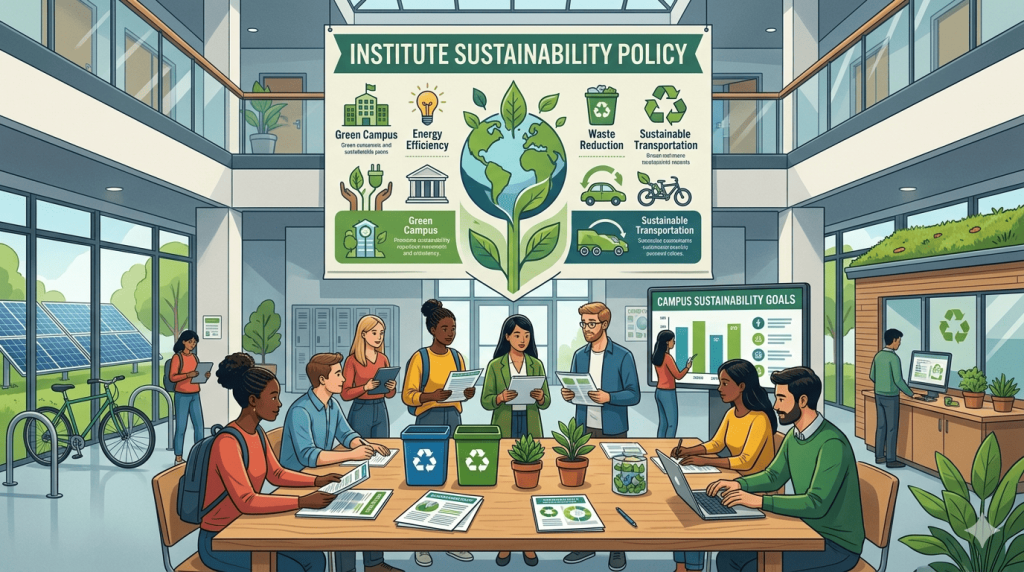
IIT envisions becoming a carbon-conscious, resource-efficient, and environmentally restorative institution that:
- Achieves net-zero carbon emissions by 2050 or earlier
- Eliminates avoidable waste through circular economy principles
- Promotes biodiversity and ecological balance within campus grounds
- Serves as a model sustainability campus for other institutions
5. Core Sustainability Principles
The Institute’s sustainability strategy is guided by the following principles:
5.1 Environmental Responsibility
Minimizing environmental impact through efficient resource use and pollution prevention.
5.2 Social Equity
Ensuring inclusive access to education, employment, and resources while promoting well-being.
5.3 Economic Efficiency
Optimizing resource use to reduce costs and improve long-term financial sustainability.
5.4 Innovation and Research
Encouraging innovation in sustainable technologies, systems, and practices.
5.5 Accountability and Transparency
Maintaining clear reporting systems and performance tracking mechanisms.
6. Governance Structure
To ensure effective implementation, IIT will establish a Sustainability Governance Framework:
6.1 Sustainability Council
A central governing body responsible for policy oversight, chaired by a senior academic leader.
6.2 Sustainability Office
A dedicated operational unit responsible for coordination, monitoring, and reporting.
6.3 Departmental Sustainability Coordinators
Each department will appoint a coordinator to implement initiatives at the local level.
6.4 Student Sustainability Committee
A student-led body to encourage participation, innovation, and awareness.
7. Energy Management
Energy consumption is one of the largest contributors to IIT’s environmental footprint.
7.1 Energy Efficiency
The Institute will:
- Upgrade to energy-efficient lighting (LED systems)
- Implement smart building energy management systems
- Optimize HVAC systems
- Conduct regular energy audits
7.2 Renewable Energy
IIT will:
- Install solar photovoltaic systems across campus rooftops
- Explore wind and hybrid energy solutions where feasible
- Aim for at least 60% renewable energy use by 2035
7.3 Energy Conservation Practices
- Awareness campaigns for responsible energy use
- Automatic shutdown systems for idle equipment
- Green IT practices in data centers
8. Water Management
Water conservation is essential for long-term sustainability.
8.1 Water Efficiency
- Installation of low-flow fixtures
- Smart irrigation systems for landscaping
- Leak detection and repair systems
8.2 Rainwater Harvesting
- Mandatory rainwater harvesting systems in all new buildings
- Recharge wells and groundwater replenishment systems
8.3 Wastewater Treatment
- On-site sewage treatment plants
- Reuse of treated water for gardening and flushing
9. Waste Management
IIT is committed to achieving a zero-waste campus.
9.1 Waste Segregation
- Mandatory segregation at source (organic, recyclable, hazardous)
9.2 Recycling and Reuse
- Partnerships with recycling agencies
- Promotion of circular economy practices
9.3 Organic Waste Management
- Composting units for food and garden waste
- Biogas generation systems where feasible
9.4 E-Waste Management
- Safe disposal of electronic waste through certified vendors
10. Sustainable Procurement
The procurement process will integrate sustainability criteria:
- Preference for eco-labeled products
- Local sourcing to reduce transportation emissions
- Lifecycle cost analysis over upfront cost considerations
- Avoidance of single-use plastics
11. Transportation and Mobility
11.1 Sustainable Transport Options
- Promotion of cycling and walking infrastructure
- Shuttle services using electric vehicles
11.2 Public Transport Encouragement
- Incentives for using public transportation
11.3 Vehicle Emission Reduction
- Gradual transition to electric fleet vehicles
- Installation of EV charging stations on campus
12. Sustainable Buildings and Infrastructure
All new buildings must comply with green building standards:
- Energy-efficient architectural design
- Natural ventilation and lighting
- Use of sustainable building materials
- Green certifications (e.g., LEED or equivalent)
13. Curriculum Integration
Sustainability will be embedded across academic programs:
- Mandatory sustainability modules for all students
- Interdisciplinary courses on climate science, environmental engineering, and sustainable development
- Hands-on sustainability projects
14. Research and Innovation
IIT will promote research in:
- Renewable energy technologies
- Climate change mitigation and adaptation
- Sustainable materials
- Environmental policy and economics
Funding and grants will be prioritized for sustainability-focused research.
15. Campus Biodiversity
The Institute will:
- Develop green belts and native plant zones
- Protect existing biodiversity
- Avoid chemical pesticides and fertilizers
- Conduct periodic biodiversity assessments
16. Digital Sustainability
- Energy-efficient data centers
- Cloud optimization strategies
- Paperless administration systems
- Responsible use of IT infrastructure
17. Stakeholder Engagement
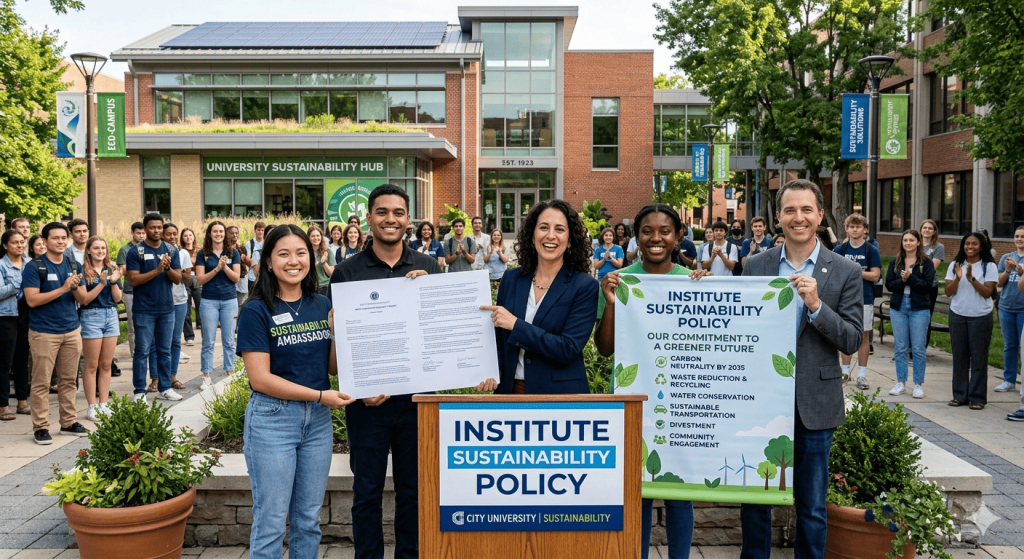
Sustainability requires collective participation:
- Awareness campaigns for students and staff
- Community outreach programs
- Partnerships with industry and NGOs
18. Training and Capacity Building
Regular training programs will be conducted for:
- Facility management staff
- Faculty and researchers
- Students and volunteers
19. Monitoring and Evaluation
19.1 Key Performance Indicators (KPIs)
- Carbon emissions per capita
- Energy consumption per square meter
- Water usage efficiency
- Waste diversion rate
19.2 Reporting
- Annual sustainability report
- Public disclosure of environmental performance
19.3 Auditing
- Internal and external sustainability audits
20. Targets and Timelines
- Short-term (1–3 years): Energy audits, waste segregation, awareness programs
- Medium-term (3–10 years): 50% renewable energy adoption, major waste reduction
- Long-term (10–25 years): Net-zero carbon emissions, circular campus system
21. Compliance and Legal Framework
IIT will comply with:
- National environmental regulations
- Local municipal laws
- International sustainability frameworks
22. Continuous Improvement
The International Institute of Technology (IIT) recognizes that sustainability is a dynamic and evolving field shaped by emerging scientific knowledge, technological advancements, policy developments, and changing societal expectations. In this context, no sustainability framework can remain static if it is to remain effective and relevant. Continuous improvement is therefore a fundamental principle of this Sustainability Policy, ensuring that the Institute’s commitments, strategies, and actions are regularly assessed, refined, and strengthened over time.
To operationalize this principle, the policy will undergo a formal review every three years. This structured review cycle is designed to provide sufficient time for the implementation of initiatives, the collection of measurable outcomes, and the assessment of progress against defined sustainability objectives. A three-year interval also ensures that the policy remains responsive to both short-term developments and long-term strategic priorities. However, IIT also acknowledges that significant environmental, technological, or regulatory changes may necessitate interim adjustments where required.
The review process will be comprehensive, evidence-based, and participatory. It will assess the effectiveness of current sustainability initiatives across all institutional domains, including governance, academic programs, research activities, campus operations, and community engagement. Key performance indicators (KPIs), environmental metrics, and sustainability benchmarks will be analyzed to determine progress toward institutional goals and alignment with broader frameworks such as the United Nations Sustainable Development Goals (SDGs). This data-driven approach ensures that decisions regarding policy updates are grounded in measurable outcomes rather than assumptions.
Stakeholder engagement is a central component of the continuous improvement process. IIT recognizes that meaningful sustainability progress depends on the active involvement of its diverse community, including students, faculty, administrative staff, researchers, alumni, and external partners. Each of these groups brings unique perspectives, experiences, and insights that are essential for identifying strengths, gaps, and opportunities for improvement. Accordingly, structured mechanisms will be established to gather feedback through surveys, consultations, workshops, focus groups, and institutional forums.
Student participation will be particularly emphasized, as students are both key beneficiaries and active contributors to the Institute’s sustainability initiatives. Their feedback on curriculum integration, campus sustainability practices, and engagement opportunities will play a vital role in shaping future policy directions. Similarly, faculty and researchers will provide critical input on academic and research alignment with sustainability priorities, ensuring that the Institute remains at the forefront of innovation and knowledge creation in this field.
Administrative and operational staff will also contribute valuable insights into the practical implementation of sustainability measures. Their on-the-ground experience with resource management, facility operations, and institutional processes will help identify operational inefficiencies and areas for improvement. External stakeholders, including industry partners, government agencies, and community organizations, will further enrich the review process by providing broader contextual perspectives and highlighting emerging trends and expectations.
All feedback collected through these mechanisms will be systematically documented, analyzed, and integrated into the policy review process. Transparency will be maintained throughout, with clear communication of how stakeholder inputs have influenced revisions and decision-making outcomes. This ensures accountability and fosters trust within the IIT community and beyond.
In addition to formal reviews, IIT will promote a culture of continuous learning and adaptive management. Sustainability is not only about periodic policy updates but also about ongoing reflection and responsiveness in everyday practices. Departments and units across the Institute will be encouraged to regularly evaluate their sustainability performance, share best practices, and implement incremental improvements. This decentralized approach complements the formal review cycle and ensures that sustainability remains an active and embedded part of institutional life.
Capacity building will also play a critical role in supporting continuous improvement. IIT will invest in training, professional development, and awareness programs to equip its community with the knowledge and skills necessary to identify and implement sustainability enhancements. By fostering a learning-oriented environment, the Institute ensures that individuals at all levels are empowered to contribute to ongoing progress.
Furthermore, IIT will leverage technological tools and digital systems to enhance monitoring, reporting, and evaluation processes. Data analytics, sustainability dashboards, and reporting platforms will be used to track performance in real time and support informed decision-making. These tools will improve efficiency, accuracy, and accessibility of sustainability information across the institution.
23. Conclusion
The International Institute of Technology recognizes that sustainability is not a fixed goal or a final state to be achieved, but rather a continuous and evolving journey that requires sustained commitment, reflection, and adaptation. In an era defined by rapid environmental change, resource constraints, and increasing social and economic complexity, institutions of higher education must play a proactive role in shaping a more sustainable future. This Sustainability Policy represents IIT’s formal commitment to that responsibility and sets the foundation for long-term institutional transformation.
Through the adoption and implementation of this policy, IIT reaffirms its dedication to responsible stewardship of natural, financial, and human resources. The Institute acknowledges that its operations, academic activities, and research endeavors have both direct and indirect impacts on the environment and society. As such, IIT commits to minimizing negative environmental impacts while maximizing positive contributions through sustainable practices, innovation, and leadership.
A key element of this commitment is the integration of sustainability into all aspects of institutional life. This includes embedding sustainability principles into governance structures, decision-making processes, academic curricula, research agendas, and campus operations. By doing so, IIT aims to ensure that sustainability is not treated as an isolated initiative but as a core value that informs institutional identity and culture. This integrated approach enables the Institute to align its growth and development with global sustainability priorities, including climate action, responsible consumption, biodiversity conservation, and social equity.
Innovation is central to IIT’s sustainability vision. The Institute recognizes that addressing complex global challenges requires creative thinking, interdisciplinary collaboration, and continuous improvement. IIT therefore commits to fostering a culture of innovation that encourages the development and adoption of sustainable technologies, practices, and solutions. Through research excellence and partnerships with industry, government, and civil society, IIT seeks to contribute meaningfully to global knowledge and practical solutions for sustainability challenges.
Equally important is IIT’s commitment to social and ethical responsibility. The Institute acknowledges its role in shaping future leaders who are not only technically competent but also socially conscious and environmentally responsible. By promoting sustainability education and awareness, IIT aims to empower students, faculty, and staff to make informed decisions that contribute to the well-being of society and the planet. This includes fostering inclusivity, equity, and diversity as essential components of a sustainable institutional environment.
The success of this policy depends on collective responsibility and active participation from all members of the IIT community. Sustainability cannot be achieved through institutional mandates alone; it requires a shared commitment and ongoing engagement from students, educators, researchers, administrators, and external stakeholders. IIT therefore emphasizes collaboration, transparency, and accountability as essential principles guiding the implementation of this policy.
Furthermore, IIT recognizes that sustainability is a dynamic field shaped by evolving scientific knowledge, technological advancements, and global policy developments. In response, this policy is designed to remain flexible and adaptive, allowing for regular review and continuous improvement. The Institute commits to monitoring progress, evaluating outcomes, and refining strategies to ensure relevance and effectiveness over time.
Table of Contents