Double Doctoral Degree Programme
1. Introduction
The Double Doctoral Degree Programme (DDDP) represents one of the most advanced forms of academic collaboration in global higher education. It allows a single doctoral candidate to pursue research under the guidance of two universities or institutions simultaneously and, upon successful completion, receive two separate doctoral degrees. This model is increasingly becoming a cornerstone of international academic cooperation, particularly in science, technology, engineering, and interdisciplinary research fields.
In an era defined by globalization, knowledge exchange, and technological advancement, the traditional boundaries of higher education are rapidly dissolving. Universities across continents are forming strategic partnerships to enhance research output, share intellectual resources, and improve academic mobility. The DDDP is a direct outcome of this transformation.
Unlike conventional PhD programmes that are confined to a single institution, the Double Doctoral Degree Programme integrates academic systems, research methodologies, and evaluation standards of two universities. This provides students with broader exposure, deeper expertise, and enhanced career opportunities in academia and industry.
Institutions such as technical universities, research institutes, and international collaborations—including organizations like the International Institute of Technology (IIT Institute)—have shown increasing interest in dual doctoral frameworks to promote cross-border academic development.
2. Definition and Conceptual Framework
A Double Doctoral Degree Programme can be defined as a structured academic arrangement in which a doctoral candidate conducts a single research project under the supervision of two universities and fulfills the academic requirements of both institutions, leading to the award of two separate PhD degrees.
The core idea is that instead of producing two independent doctoral theses, the student produces a single unified research work that satisfies dual academic standards. The candidate is supervised by faculty members from both institutions and is subject to evaluation processes from both sides.
The conceptual foundation of DDDP is built on three major pillars:
2.1 Academic Collaboration
Two institutions collaborate to design a shared research framework that aligns with mutual academic interests.
2.2 Research Integration
The student works on a single research topic that contributes to both academic environments.
2.3 Dual Recognition
Both institutions independently award a PhD degree based on the same research output.
This model differs from traditional joint degrees, cotutelle agreements, or dual master’s programmes because it involves the highest level of academic qualification—doctoral research.
3. Evolution of Double Doctoral Programmes
The origin of dual doctoral frameworks can be traced back to Europe in the late 20th century, when universities began experimenting with cross-border academic cooperation. The Bologna Process, which aimed to standardize higher education across Europe, played a crucial role in enabling such collaborations.
France and Germany were among the early adopters of cotutelle PhD agreements, which later evolved into more formalized double degree structures. As globalization increased, universities in Asia, North America, and Australia began participating in similar arrangements.
India’s premier institutions, particularly the International Institute of Technology (IIT), have actively engaged in international doctoral collaborations with universities in Japan, Germany, Australia, the United Kingdom, and the United States.
These partnerships were driven by the need to:
- Increase research visibility
- Enhance academic reputation
- Provide students with global exposure
- Foster innovation through cross-cultural collaboration
Over time, the DDDP evolved into a structured academic model governed by Memorandums of Understanding (MoUs) between institutions.
4. Objectives of the Double Doctoral Degree Programme
The DDDP is designed to serve multiple academic and strategic objectives:
4.1 Enhancement of Research Quality
By combining expertise from two institutions, research quality improves significantly.
4.2 International Exposure
Students gain access to two academic cultures, improving adaptability and global competence.
4.3 Resource Optimization
Laboratories, libraries, datasets, and funding resources are shared.
4.4 Academic Networking
Students build international research networks that benefit future collaborations.
4.5 Innovation Promotion
Exposure to diverse methodologies leads to innovative solutions in research.
4.6 Career Advancement
Graduates are more competitive in global academic and industrial job markets.
5. Structural Design of the Programme
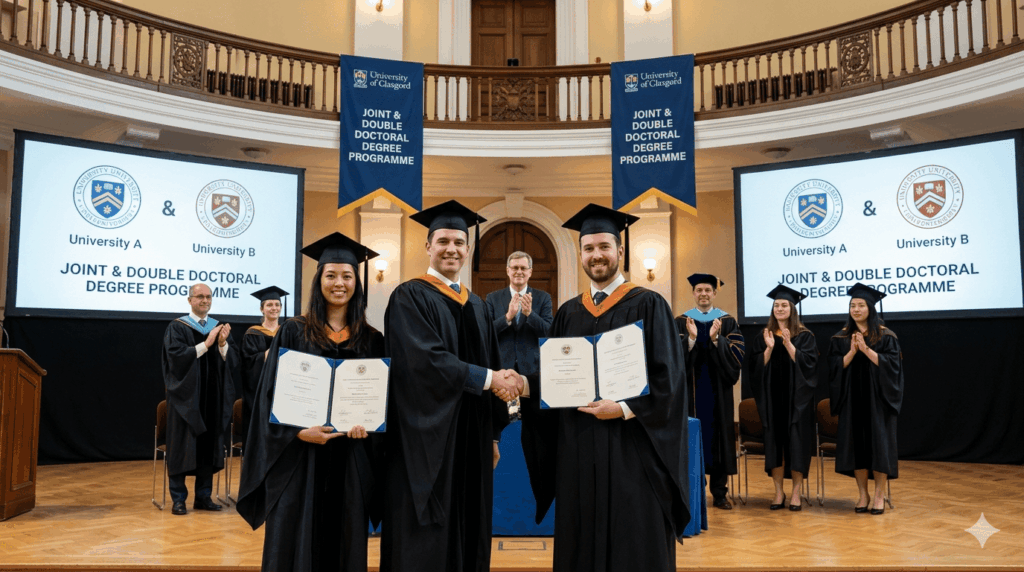
The structure of a Double Doctoral Degree Programme is complex and requires careful coordination between institutions.
5.1 Admission Process
Admission typically requires approval from both institutions. The candidate applies through one university (home institution), which then coordinates with the partner institution.
Key requirements include:
- Strong academic record
- Research proposal alignment
- Supervisor availability
- Language proficiency (for international programmes)
5.2 Research Phases
The research is typically divided into multiple phases:
Phase 1: Initial Research (Home Institution)
- Coursework (if required)
- Literature review
- Research proposal development
Phase 2: Advanced Research (Host Institution)
- Experimental work or field research
- Data collection and analysis
Phase 3: Integration Phase
- Data consolidation
- Comparative analysis
- Joint supervision feedback
Phase 4: Thesis Completion
- Writing and final submission
- Review by both institutions
5.3 Supervision Model
Each student is supervised by:
- A primary supervisor from the home institution
- A co-supervisor from the partner institution
Supervisory committees ensure consistent progress evaluation.
5.4 Evaluation Mechanism
Evaluation includes:
- Progress reports
- Research presentations
- Joint defense examinations
6. Degree Awarding System
One of the defining features of the DDDP is the dual degree outcome.
6.1 Double Degree Model
The most common outcome is two separate PhD certificates awarded independently by both institutions. Each certificate recognizes the same research work.
6.2 Joint Degree Model
In some cases, a single certificate is issued jointly by both universities. However, this is less common due to institutional accreditation differences.
6.3 Thesis Requirement
A single dissertation is submitted, reviewed by both institutions, and defended according to jointly established criteria.
7. Eligibility Criteria
Eligibility for admission into a DDDP is stringent:
7.1 Academic Qualification
A master’s degree in a relevant field is typically required.
7.2 Academic Performance
High academic achievement is essential, often with minimum CGPA requirements.
7.3 Research Proposal
A detailed and feasible research proposal must be submitted.
7.4 Supervisor Approval
Both institutions must agree on supervision arrangements.
7.5 Language Proficiency
International students must meet language requirements such as IELTS or TOEFL.
8. Funding and Financial Support
Funding is a crucial component of DDDP participation.
8.1 Types of Funding
- Government scholarships
- Institutional fellowships
- Research grants
- Industry-sponsored projects
8.2 Financial Benefits
Students may receive:
- Monthly stipends
- Tuition fee waivers
- Travel grants between institutions
8.3 Challenges in Funding
Securing continuous funding for international research mobility remains a major challenge.
9. Duration of Programme
The duration of the Double Doctoral Degree Programme (DDDP) is one of its most critical structural components, as it directly influences research planning, funding allocation, academic progression, and international mobility. Typically, the programme spans between 3.5 to 6 years, although in certain cases it may extend beyond this range depending on institutional policies and research complexity. Unlike conventional PhD programmes, where timelines are relatively uniform within a single institution, the DDDP involves coordination between two academic systems, which naturally introduces variability in completion time.
9.1 Standard Duration Framework
In most structured DDDP agreements, particularly those involving research-intensive universities, the expected duration is divided into phases. The first phase usually includes coursework, research proposal development, and initial literature review, often completed within the first 6 to 12 months at the home institution. The second phase focuses on advanced research work and data collection at the partner institution, which may last between 12 to 24 months depending on the field of study.
The final phase is dedicated to thesis writing, publication preparation, and joint evaluation. This stage typically requires 12 to 18 months, during which the candidate consolidates research outcomes from both institutions into a unified doctoral dissertation.
9.2 Influence of Research Complexity
One of the most significant factors affecting duration is the complexity of the research topic. In fields such as artificial intelligence, nanotechnology, biotechnology, and advanced materials science, experimental cycles are often lengthy and require iterative validation. For example, laboratory-based research may require repeated trials, equipment calibration, and long-term data observation, which can extend the programme duration closer to the upper limit of six years.
In contrast, theoretical or computational research, such as mathematical modeling, data analytics, or computer simulations, may progress more quickly due to reduced dependency on physical experimentation. However, even in such cases, dual institutional requirements can still extend timelines due to additional review cycles.
9.3 Institutional Regulations and Academic Policies
Each participating institution in a DDDP has its own doctoral regulations, which significantly influence the overall timeline. Some universities impose strict minimum residency requirements, mandating that students spend a defined period physically present on campus. Others require completion of mandatory coursework or research credits before allowing thesis submission.
Differences in academic calendars between countries can also contribute to delays. For instance, one institution may operate on a semester system while the other follows a trimester or quarterly structure. Aligning milestones such as progress reviews, comprehensive examinations, and thesis submission deadlines requires careful coordination between both universities.
9.4 Funding Availability and Financial Constraints
Funding plays a crucial role in determining how smoothly a DDDP progresses. Students often rely on scholarships, research assistantships, or external grants to support their studies. If funding is continuous and stable, students can focus entirely on research activities, thereby completing the programme within the minimum timeframe.
However, interruptions in funding may cause delays, forcing students to take breaks, seek additional financial support, or extend their candidature. International mobility costs, including travel, accommodation, and visa-related expenses, further influence duration. In some cases, delays in grant approvals or institutional budget cycles can add several months to the programme timeline.
9.5 Publication and Thesis Requirements
Most DDDP agreements require doctoral candidates to publish their research findings in peer-reviewed journals before thesis submission. Depending on the institution, students may need to publish between one and five research papers in indexed journals.
The peer-review process itself can be time-consuming, often taking several months per submission cycle. Revisions requested by reviewers, rejection from journals, or multiple submission attempts can significantly extend the overall duration. Additionally, both institutions may require separate thesis evaluations, external examiner reviews, and joint defense preparations, all of which contribute to the total time required for completion.
9.6 Administrative and Logistical Delays
Administrative coordination between two universities is another major factor affecting programme duration. Tasks such as credit transfer approvals, supervision committee meetings, ethics clearances, and documentation verification often require formal communication between institutions.
Visa processing delays, travel restrictions, or geopolitical issues may also impact the student’s ability to move between partner universities. These external factors are unpredictable and can add months or even years to the originally planned timeline.
9.7 Extended Duration Cases
In some cases, the DDDP may extend beyond six years. This usually occurs when students undertake highly ambitious interdisciplinary research projects, encounter experimental setbacks, or experience prolonged publication delays. While extensions are generally permitted, they require formal approval from both institutions and justification of academic progress.
9.8 Comparative Perspective
Compared to a traditional single-institution PhD, which typically lasts 3 to 5 years, the DDDP requires slightly more time due to its dual institutional structure. However, the additional duration is often justified by the increased academic value, international exposure, and dual degree outcome.
Overall, the duration of the Double Doctoral Degree Programme reflects a balance between depth of research, institutional coordination, and global academic standards. Proper planning, strong supervision, and stable funding are essential to completing the programme efficiently.
10. Advantages of DDDP
10.1 Academic Advantages
- Access to dual supervision
- Enhanced research quality
- Broader academic exposure
10.2 Professional Advantages
- Higher employability
- International career opportunities
- Strong academic reputation
10.3 Research Advantages
- Multi-institutional resources
- Diverse methodological exposure
- Increased publication output
10.4 Institutional Advantages
- Strengthened global partnerships
- Increased research funding opportunities
11. Challenges and Limitations
Despite its advantages, the programme faces several challenges:
11.1 Administrative Complexity
Coordinating two academic systems is difficult.
11.2 Cultural and Academic Differences
Differences in academic expectations may create confusion.
11.3 Financial Constraints
Sustaining international mobility is expensive.
11.4 Time Management Issues
Balancing requirements of two institutions increases workload.
11.5 Visa and Mobility Barriers
International travel restrictions may delay progress.
12. Case Studies and Global Implementation
12.1 European Universities
European institutions have been pioneers in double doctoral frameworks, particularly under Erasmus-related programmes.
12.2 Asian Collaborations
Universities in India, Japan, and Singapore actively participate in dual PhD programmes.
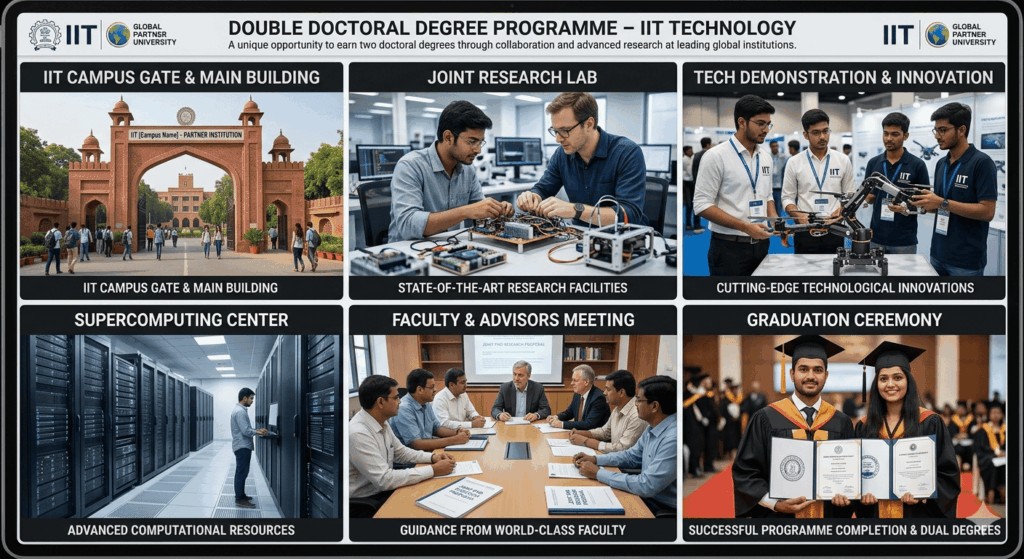
12.3 IIT Collaborations
International Institute of Technology have established MoUs with global universities to implement structured double doctoral programmes in engineering, science, and technology fields.
13. Role of International Institute of Technology (IIT Institute)
Institutions like the International Institute of Technology (IIT Institute) contribute to the growing trend of international doctoral education by offering:
- Cross-border academic programmes
- Industry-integrated research opportunities
- Flexible doctoral pathways
- Collaboration with global universities
Such institutions aim to bridge the gap between academic research and industrial application, particularly in emerging technologies.
14. Comparison with Other Doctoral Models
| Feature | Single PhD | Joint PhD | Double Doctoral Degree |
|---|---|---|---|
| Degrees | 1 | 1 | 2 |
| Institutions | 1 | 2 | 2 |
| Thesis | 1 | 1 | 1 |
| Complexity | Medium | High | Very High |
| Global Exposure | Limited | High | Very High |
15. Future Scope of DDDP
The future of double doctoral programmes is promising due to:
15.1 Globalization of Education
Increasing demand for international qualifications.
15.2 Technological Advancements
Digital research tools enable remote collaboration.
15.3 Industry-Academia Integration
Companies seek highly skilled researchers.
15.4 Policy Support
Governments encourage international academic partnerships.
16. Ethical and Academic Considerations
DDDP programmes must maintain:
- Academic integrity
- Equal contribution from both institutions
- Transparent evaluation processes
- Fair intellectual property agreements
17. Conclusion
The Double Doctoral Degree Programme represents a significant advancement in global higher education. It enables students to pursue high-level research across two institutions and earn dual recognition for their academic contributions. While the programme is demanding and complex, it offers unparalleled academic, professional, and research advantages.
As universities continue to globalize, the DDDP is expected to become more common, especially in fields requiring interdisciplinary and international collaboration. Institutions like IITs and international technology universities will play a key role in shaping the future of this academic model.
Table of Contents