Institute Vision and Mission
International Institute of Technology (IIT)
1. Introduction
The vision and mission of an academic institution form the philosophical backbone that guides its development, operations, and long-term aspirations. For an institution like the International Institute of Technology (IIT), these statements are not merely symbolic declarations but strategic commitments that influence teaching methodologies, research priorities, student development, and societal engagement.
In the modern global landscape, institutions of higher education are expected to go beyond traditional roles of imparting knowledge. They must act as innovation hubs, centers of excellence, and catalysts for socio-economic transformation. The vision and mission of IIT reflect this expanded responsibility by emphasizing quality education, technological advancement, global competitiveness, and ethical values.
Globally recognized institutions such as International Institute of Technology highlight the importance of integrating research, innovation, and societal development into their core philosophy. Similarly, IIT as an international institute aspires to align itself with such standards to create a dynamic and future-ready educational ecosystem.
2. Concept of Vision and Mission in Higher Education
2.1 What is Vision?
A vision statement defines the long-term aspirations of an institution. It answers the question: What does the institution aim to become in the future?
Vision statements in premier institutions often focus on:
- Global recognition
- Academic excellence
- Innovation leadership
- Societal impact
For example, many leading institutes aim to be “globally recognized centers of excellence in education and research,” reflecting a commitment to innovation and leadership.
2.2 What is Mission?
A mission statement defines the present purpose of the institution. It answers:
- Why does the institution exist?
- What does it do?
- How does it serve its stakeholders?
Mission statements typically emphasize:
- Quality education
- Research and innovation
- Skill development
- Ethical and social responsibility
Institutions emphasize “providing relevant education in an environment of knowledge creation and innovation,” highlighting their dual focus on teaching and research.
3. Vision of International Institute of Technology (IIT)
3.1 Core Vision Statement
The vision of the International Institute of Technology (IIT) can be articulated as:
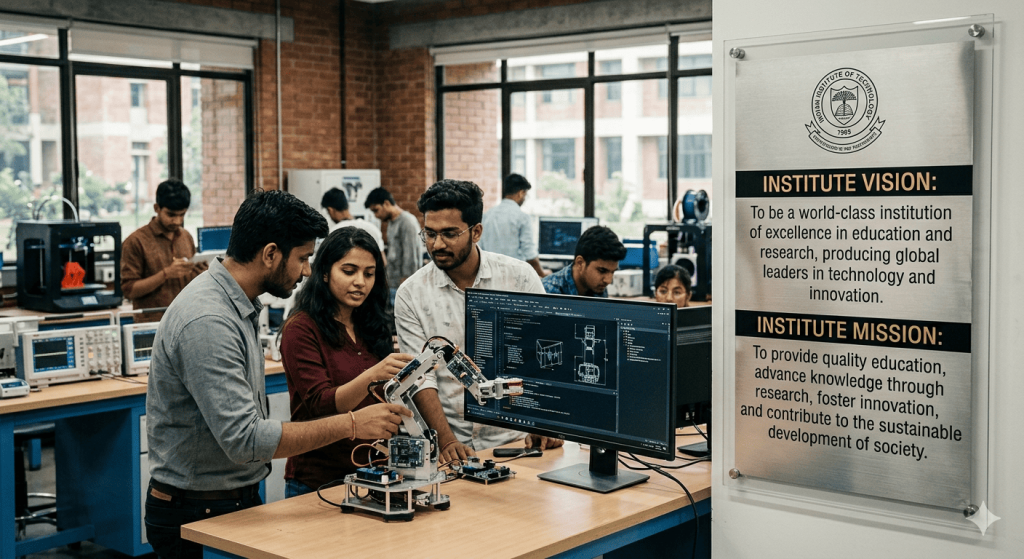
To be a globally recognized center of excellence in technical education, research, and innovation, committed to developing competent professionals and leaders who contribute to technological advancement and societal development.
3.2 Key Components of the Vision
3.2.1 Global Recognition
The institute aims to establish itself on an international platform by:
- Collaborating with global universities
- Encouraging international research partnerships
- Attracting diverse student populations
This aligns with global trends where institutions strive for internationalization and global rankings.
3.2.2 Academic Excellence
Excellence in education is achieved through:
- Updated curricula aligned with industry standards
- Outcome-based education (OBE)
- Continuous assessment and improvement
Top institutions emphasize “transformative education and leadership development,” highlighting the importance of quality learning experiences.
3.2.3 Innovation and Research Leadership
Innovation is central to IIT’s vision. This includes:
- Promoting interdisciplinary research
- Encouraging patents and startups
- Developing incubation centers
Institutions aim to “advance knowledge through research and scholarship,” reinforcing the importance of innovation-driven growth.
3.2.4 Societal Contribution
The institute envisions contributing to:
- Sustainable development
- Technological solutions for societal challenges
- Community engagement
Leading IITs emphasize solving “problems faced by the nation and the world,” demonstrating the importance of societal impact.
3.2.5 Ethical and Value-Based Education
Ethics and values form a crucial part of the vision:
- Integrity
- Accountability
- Professional ethics
Institutions adopt core values such as integrity, excellence, and empathy as guiding principles.
4. Mission of International Institute of Technology (IIT)

4.1 Core Mission Statement
To provide high-quality technical education through innovative teaching-learning processes, foster research and development, promote industry collaboration, and nurture socially responsible and ethically grounded professionals.
4.2 Key Elements of the Mission
4.2.1 Quality Education
The institute is committed to:
- Delivering industry-relevant education
- Integrating theory with practical applications
- Developing critical thinking skills
4.2.2 Research and Development
The mission emphasizes:
- Encouraging faculty and student research
- Establishing research centers
- Publishing in reputed journals
Research is essential for addressing real-world challenges and advancing knowledge.
4.2.3 Industry Interaction
To bridge the gap between academia and industry, IIT focuses on:
- Internships and training programs
- Industry-sponsored projects
- Guest lectures by professionals
4.2.4 Skill Development
The institute aims to develop:
- Technical skills
- Soft skills
- Leadership qualities
This ensures students are employable and industry-ready.
4.2.5 Social Responsibility
The mission includes:
- Promoting community development
- Encouraging sustainable practices
- Addressing societal challenges
4.2.6 Lifelong Learning
Students are encouraged to:
- Continuously upgrade skills
- Adapt to technological changes
- Engage in self-learning
5. Core Values of the Institute
Values are the guiding principles that shape institutional culture.
5.1 Integrity
Maintaining honesty and ethical standards in all activities.
5.2 Excellence
Striving for the highest standards in education, research, and innovation.
5.3 Innovation
Encouraging creativity and new ideas.
5.4 Inclusiveness
Promoting diversity and equal opportunities.
5.5 Accountability
Being responsible to stakeholders and society.
6. Objectives Derived from Vision and Mission
6.1 Academic Objectives
- Provide world-class education
- Enhance teaching methodologies
- Improve student outcomes
6.2 Research Objectives
- Promote interdisciplinary research
- Increase research publications
- Develop innovative solutions
6.3 Institutional Objectives
- Strengthen infrastructure
- Improve global rankings
- Enhance collaborations
6.4 Student Development Objectives
- Develop leadership qualities
- Encourage entrepreneurship
- Promote ethical values
7. Strategic Implementation of Vision and Mission
7.1 Curriculum Development
- Industry-aligned syllabus
- Regular updates
- Inclusion of emerging technologies
7.2 Faculty Development
- Training programs
- Research incentives
- International exposure
7.3 Infrastructure Development
- Modern laboratories
- Digital libraries
- Smart classrooms
7.4 Industry Collaboration
- MoUs with companies
- Joint research projects
- Internship opportunities
7.5 Research Promotion
- Funding support
- Innovation labs
- Startup incubation
8. Role of Vision and Mission in Institutional Growth
The vision and mission of an educational institution play a crucial role in shaping its growth, development, and long-term success. They serve as guiding principles that influence every aspect of the institution, from academic planning to administrative decisions. For an institution like the International Institute of Technology (IIT), the vision and mission act as a foundation upon which all strategies, policies, and actions are built.
A well-defined vision provides a clear picture of what the institution aspires to achieve in the future, while the mission outlines the steps required to reach that destination. Together, they ensure that the institution moves in a consistent and purposeful direction, maintaining alignment between its goals and activities. The role of vision and mission in institutional growth can be understood through several key aspects, including direction and focus, decision-making, motivation, and reputation building.
8.1 Direction and Focus
One of the most important roles of vision and mission is to provide a clear direction and focus for the institution. In the absence of a well-defined vision, an institution may struggle with ambiguity and lack of coherence in its activities. The vision acts as a roadmap that outlines the long-term goals and aspirations, helping the institution to prioritize its efforts and resources effectively.
For example, if the vision emphasizes becoming a global center of excellence in technical education, the institution will focus on improving academic standards, enhancing research capabilities, and fostering international collaborations. This clarity ensures that all departments and stakeholders work toward a common objective.
The mission complements the vision by translating these long-term goals into actionable steps. It provides guidance on how the institution should operate on a day-to-day basis to achieve its broader objectives. This alignment between vision and mission helps maintain consistency in planning and execution.
Furthermore, direction and focus are essential for sustainable growth. Institutions often face multiple opportunities and challenges, and without a clear sense of direction, it becomes difficult to make informed choices. The vision and mission act as a compass, enabling the institution to stay on track and avoid distractions that do not align with its core objectives.
8.2 Decision-Making
Vision and mission play a critical role in guiding decision-making processes within an institution. Every decision, whether related to academics, administration, or infrastructure, should align with the institution’s vision and mission. This ensures that all actions contribute to the overall growth and development of the organization.
For instance, when introducing new academic programs, the institution must evaluate whether they align with its mission of providing quality education and promoting innovation. Similarly, decisions regarding investments in infrastructure, research initiatives, or faculty recruitment should support the long-term vision.
Having a clear vision and mission simplifies decision-making by providing a framework for evaluating alternatives. It helps administrators and leaders to assess whether a particular course of action is beneficial for the institution in the long run. This reduces the risk of inconsistent or short-term decisions that may hinder growth.
Moreover, vision-driven decision-making promotes accountability and transparency. When decisions are based on clearly defined goals and values, it becomes easier to justify them to stakeholders, including students, faculty, and governing bodies. This builds trust and ensures that all members of the institution are aligned with its objectives.
8.3 Motivation
Another significant role of vision and mission is to motivate and inspire students, faculty, and staff. A compelling vision creates a sense of purpose and belonging, encouraging individuals to contribute actively to the institution’s growth.
For students, the vision provides a sense of direction and aspiration. It helps them understand the broader purpose of their education and motivates them to strive for excellence. When students feel that they are part of an institution with a strong vision, they are more likely to be engaged, committed, and driven to succeed.
Faculty members also benefit from a clear mission and vision. It guides their teaching, research, and professional development efforts. A well-defined mission encourages faculty to adopt innovative teaching methods, engage in meaningful research, and contribute to the institution’s goals.
Additionally, the vision and mission foster a positive organizational culture. They create a shared sense of identity and values, promoting collaboration and teamwork among stakeholders. This collective effort is essential for achieving institutional objectives and sustaining growth.
Motivation derived from vision and mission is not limited to internal stakeholders. It also inspires external partners, such as industry collaborators and alumni, to engage with the institution and support its initiatives.
8.4 Reputation Building
Vision and mission play a vital role in building and enhancing the reputation of an institution. A strong and well-articulated vision reflects the institution’s aspirations and commitment to excellence, while the mission demonstrates its dedication to achieving those goals.
Reputation is a key factor in attracting students, faculty, and funding. Institutions with a clear vision and mission are perceived as more credible and trustworthy. They are better positioned to establish partnerships with industry and other academic institutions, both nationally and internationally.
For example, an institution that emphasizes innovation and research in its vision is likely to gain recognition for its contributions to technological advancement. Similarly, a mission focused on quality education and ethical values enhances the institution’s image as a responsible and reliable organization.
Furthermore, a strong reputation contributes to long-term sustainability. It helps the institution maintain a competitive edge in the education sector and ensures continued growth and development.
In today’s globalized world, reputation is closely linked to visibility and impact. Institutions that consistently align their actions with their vision and mission are more likely to achieve recognition and respect at both national and international levels.
9. Comparison with Leading Institutions
Leading institutions like IITs emphasize:
- Global excellence
- Innovation
- Societal impact
For instance, IITs aim to create “leaders and innovators” and foster research-driven education.
Similarly, international universities focus on interdisciplinary learning and global collaboration.
10. Challenges in Achieving Vision and Mission
While the vision and mission of an educational institution provide a strong foundation for growth and development, achieving them is often accompanied by numerous challenges. Institutions like the International Institute of Technology (IIT) operate in a dynamic and competitive environment where continuous adaptation is essential. These challenges can affect the institution’s ability to maintain quality, relevance, and global competitiveness. Understanding these obstacles is crucial for developing effective strategies to overcome them.
10.1 Rapid Technological Changes
One of the most significant challenges faced by modern educational institutions is the rapid pace of technological advancement. Technology is continuously evolving, and new developments in fields such as artificial intelligence, data science, robotics, and cloud computing are transforming industries at an unprecedented rate.
For an institution aiming to provide high-quality technical education, keeping the curriculum updated becomes a major challenge. Traditional curricula can quickly become outdated if they do not incorporate the latest advancements. This creates a gap between what students learn and what is required in the industry.
Updating the curriculum regularly requires:
- Continuous review and revision processes
- Training faculty in emerging technologies
- Investing in modern laboratories and equipment
However, these changes demand time, expertise, and financial resources. Additionally, faculty members must adapt to new teaching methodologies and tools, such as digital platforms and online learning systems.
Another challenge is balancing foundational knowledge with emerging trends. While it is important to include new technologies, institutions must also ensure that students have a strong understanding of core concepts. Achieving this balance is essential but often difficult.
10.2 Global Competition
In today’s globalized world, educational institutions face intense competition from both national and international universities. Institutions are no longer competing only at a local or regional level; they must meet global standards to attract students, faculty, and research opportunities.
Maintaining high academic standards is a constant challenge. Leading institutions invest heavily in research, infrastructure, and faculty development, setting benchmarks that others must strive to match. For institutions like IIT, competing with globally recognized universities requires continuous improvement in quality and performance.
Global competition also affects:
- Student admissions
- Faculty recruitment
- Research funding
- International collaborations
Students today have access to a wide range of options, including online courses and foreign universities. To remain competitive, institutions must offer unique value propositions, such as specialized programs, strong industry connections, and global exposure.
Moreover, ranking systems and accreditation bodies play a significant role in shaping institutional reputation. Achieving high rankings requires consistent performance across multiple parameters, including teaching quality, research output, and internationalization.
10.3 Resource Constraints
Another major challenge in achieving the vision and mission is the limitation of resources. Educational institutions require substantial financial, human, and physical resources to operate effectively and achieve their goals.
Funding is often a critical issue, especially for institutions that aim to develop advanced infrastructure and research facilities. Establishing state-of-the-art laboratories, libraries, and digital learning environments requires significant investment. Limited funding can restrict the institution’s ability to expand and innovate.
Human resources also play a crucial role. Recruiting and retaining qualified faculty members is a challenge, particularly in specialized fields where demand is high. Institutions must offer competitive salaries, research opportunities, and professional development programs to attract talented educators.
Infrastructure constraints can further hinder growth. Inadequate facilities may affect the quality of education and limit the institution’s ability to accommodate increasing student populations. Additionally, maintaining and upgrading existing infrastructure requires ongoing investment.
Efficient resource management is essential to overcome these challenges. Institutions must prioritize their needs, optimize resource utilization, and explore alternative funding sources such as industry partnerships and research grants.
10.4 Industry Expectations
The expectations of the industry are constantly evolving, and educational institutions must adapt to meet these demands. Employers today seek graduates who possess not only technical knowledge but also practical skills, problem-solving abilities, and adaptability.
One of the key challenges is bridging the gap between academic learning and industry requirements. Traditional teaching methods may not always align with real-world applications, leading to a mismatch between graduate skills and employer expectations.
To address this challenge, institutions must:
- Incorporate practical training and internships
- Collaborate with industry partners
- Update course content based on industry trends
However, maintaining strong industry connections requires continuous effort and coordination. Industries themselves are dynamic, and their requirements can change rapidly. Institutions must remain flexible and responsive to these changes.
Another challenge is the integration of soft skills, such as communication, teamwork, and leadership, into the curriculum. While technical skills are essential, employers increasingly value well-rounded individuals who can adapt to diverse work environments.
Furthermore, the rise of automation and digital transformation has changed the nature of jobs. Institutions must prepare students for future roles that may not yet exist, which requires forward-thinking and innovative approaches to education.
11. Future Directions
11.1 Digital Transformation
- Online learning platforms
- AI-based education
11.2 Global Collaboration
- International partnerships
- Student exchange programs
11.3 Sustainable Development
- Green campus initiatives
- Renewable energy use
11.4 Innovation Ecosystem
- Startup incubation
- Research commercialization
12. Conclusion
The vision and mission of the International Institute of Technology (IIT) serve as a foundation for its growth and development. They define the institute’s aspirations and guide its actions toward achieving excellence in education, research, and societal contribution.
By focusing on innovation, global standards, and ethical values, IIT aims to produce competent professionals and responsible citizens who can address the challenges of the modern world. The alignment of vision and mission with strategic goals ensures that the institute remains relevant, competitive, and impactful in the ever-evolving landscape of higher education.
Ultimately, the success of an institution lies in its ability to translate its vision into reality and fulfill its mission through consistent efforts, continuous improvement, and unwavering commitment to excellence.
Table of Contents