Hub for Technology Innovation
International Institute of Technology (IIT)
Introduction
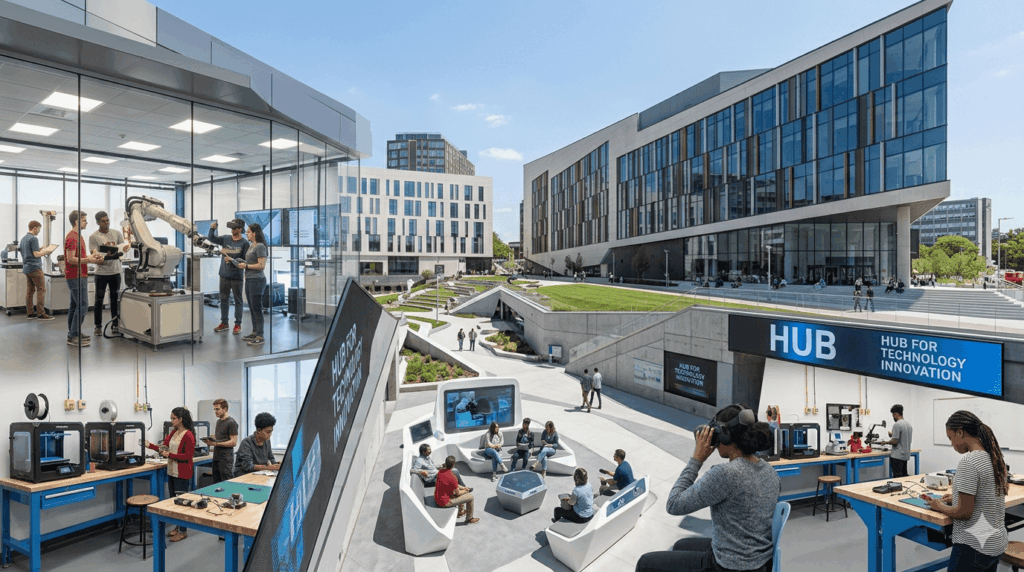
The Hub for Technology Innovation at IIT represents a progressive step toward redefining how education, research, and industry collaboration intersect. It is not just a physical space filled with advanced tools and laboratories, but a thriving ecosystem that fosters creativity, encourages experimentation, and transforms ideas into real-world solutions. This hub reflects IIT’s commitment to preparing students and professionals for the demands of a technology-driven future while also contributing meaningfully to global innovation.
At its core, the innovation hub is designed to bring together diverse groups of individuals, including students, faculty members, researchers, entrepreneurs, and industry professionals. This collaborative environment encourages the exchange of ideas, promotes interdisciplinary thinking, and enables participants to approach problems from multiple perspectives. By doing so, it helps generate innovative solutions that are not only technically sound but also practical and impactful.
One of the defining features of the Hub for Technology Innovation is its focus on bridging the gap between theoretical knowledge and practical application. Traditional education often emphasizes concepts and theories, but the innovation hub ensures that learners go beyond textbooks. It provides opportunities to work on live projects, develop prototypes, and engage in hands-on experimentation. This experiential learning approach equips students with the skills and confidence needed to tackle real-world challenges effectively.
Moreover, the hub actively promotes a culture of entrepreneurship. In today’s competitive landscape, innovation is closely linked with the ability to create and scale new ventures. Recognizing this, IIT provides aspiring entrepreneurs with the necessary support, including mentorship, guidance, and access to resources. Students are encouraged to think creatively, identify market needs, and develop solutions that can be transformed into viable business ideas. This not only enhances their career prospects but also contributes to economic growth and job creation.
Another important aspect of the innovation hub is its strong connection with industry. Collaboration with industry partners ensures that the research and innovations developed at IIT are aligned with current market demands and technological trends. These partnerships provide students with exposure to real-world scenarios, allowing them to understand industry challenges and expectations. Internships, joint research projects, and industry-led workshops further strengthen this connection, making learning more relevant and impactful.
The interdisciplinary nature of the hub also plays a crucial role in fostering innovation. Complex problems in today’s world often require solutions that go beyond a single field of study. By encouraging collaboration across disciplines such as engineering, management, data science, and healthcare, the hub enables the development of comprehensive and holistic solutions. This approach not only enhances creativity but also ensures that innovations are more adaptable and scalable.
In addition to supporting students, the Hub for Technology Innovation also empowers faculty members and researchers. It provides them with a platform to pursue advanced research, collaborate with industry experts, and contribute to technological advancements. Their involvement ensures that the hub maintains high standards of academic excellence while also staying relevant to industry needs.
Furthermore, the innovation hub is committed to addressing global challenges through technology. Whether it is improving healthcare systems, promoting sustainable development, or enhancing digital connectivity, the hub encourages projects that have a positive impact on society. This focus on social responsibility ensures that innovation is not just about technological advancement but also about creating a better future for all.
The Hub for Technology Innovation at the International Institute of Technology (IIT) exemplifies the institution’s vision of transforming education through innovation and collaboration. By creating an environment that nurtures creativity, supports entrepreneurship, and connects academia with industry, IIT is shaping the next generation of innovators and leaders. The hub stands as a testament to the institute’s commitment to excellence and its role in driving technological progress in an ever-evolving global landscape.
1. Vision and Mission of the Innovation Hub
Vision
The vision of the Innovation Hub at the International Institute of Technology (IIT) is to emerge as a globally recognized center of excellence in technology innovation. This vision is rooted in the belief that innovation is the driving force behind progress, economic growth, and societal transformation. By fostering groundbreaking ideas and nurturing creative thinking, the hub aims to contribute significantly to sustainable development and long-term societal well-being.
Becoming a global center of excellence requires more than just advanced infrastructure; it demands a strong commitment to quality, collaboration, and continuous improvement. The Innovation Hub envisions creating an ecosystem where knowledge, technology, and creativity intersect seamlessly. It aspires to attract talented individuals from diverse backgrounds and provide them with the resources and opportunities needed to innovate and excel.
A key element of this vision is sustainability. In a world facing challenges such as climate change, resource scarcity, and social inequality, innovation must be responsible and future-oriented. The hub encourages the development of technologies that not only solve immediate problems but also contribute to a more sustainable and inclusive future. Whether it is through renewable energy solutions, smart infrastructure, or digital transformation, the focus remains on creating a positive and lasting impact.
Furthermore, the vision emphasizes global relevance. The Innovation Hub aims to position IIT on the international stage by fostering collaborations with global institutions, industries, and research organizations. By doing so, it ensures that the innovations developed are not limited by geographical boundaries but have the potential to address global challenges and reach wider audiences.
Mission
To achieve its ambitious vision, the Innovation Hub operates with a well-defined mission that guides its activities and initiatives. The mission reflects a commitment to excellence, innovation, and societal contribution.
Promoting a Culture of Innovation and Creativity
One of the primary objectives of the Innovation Hub is to cultivate a strong culture of innovation and creativity among students and faculty. Innovation begins with curiosity and the willingness to think differently. The hub provides an environment where individuals are encouraged to question existing norms, explore new ideas, and experiment without fear of failure.
Through workshops, hackathons, brainstorming sessions, and collaborative projects, the hub nurtures creative thinking and problem-solving skills. It emphasizes the importance of innovation as a continuous process rather than a one-time achievement. By embedding this mindset within the academic ecosystem, IIT ensures that innovation becomes an integral part of its identity.
Bridging the Gap Between Theoretical Knowledge and Practical Application
A significant challenge in traditional education is the disconnect between theory and practice. The Innovation Hub addresses this gap by providing hands-on learning opportunities that complement academic knowledge. Students are encouraged to apply theoretical concepts to real-world problems, thereby gaining practical experience and a deeper understanding of their fields.
The hub facilitates project-based learning, prototype development, and industry-driven assignments. This approach not only enhances technical skills but also prepares students to adapt to real-world challenges. By bridging this gap, the Innovation Hub ensures that graduates are not just knowledgeable but also capable and industry-ready.
Supporting Startups and Entrepreneurial Ventures
Entrepreneurship is a key driver of innovation, and the Innovation Hub is committed to supporting aspiring entrepreneurs. It provides a structured platform where students and innovators can transform their ideas into viable business ventures. From ideation to execution, the hub offers guidance at every stage of the entrepreneurial journey.
Support includes mentorship from experienced professionals, access to funding opportunities, business development assistance, and networking with industry leaders. By fostering entrepreneurship, the hub not only empowers individuals but also contributes to job creation and economic development.
Collaborating with Industries for Real-World Problem-Solving
Industry collaboration is essential for ensuring that innovation remains relevant and impactful. The Innovation Hub actively engages with industries to understand their challenges and develop practical solutions. These collaborations create opportunities for students and researchers to work on real-world problems, gaining valuable insights and experience.
Partnerships with industry also facilitate knowledge exchange, technology transfer, and joint research initiatives. This synergy between academia and industry enhances the quality of innovation and ensures that it aligns with current market needs and technological trends.
Contributing to Technological Advancements that Benefit Society
At its core, the mission of the Innovation Hub is to use technology as a tool for societal betterment. Innovation is not just about creating new products or services; it is about improving lives and addressing pressing global challenges. The hub encourages projects that focus on areas such as healthcare, education, sustainability, and digital inclusion.
By prioritizing socially relevant innovations, the hub ensures that its efforts have a meaningful impact. It instills a sense of responsibility among students and researchers, encouraging them to use their skills and knowledge for the greater good.
2. Importance of Technology Innovation in Modern Education

Technology innovation is no longer optional—it is essential. Institutions that fail to innovate risk becoming obsolete in a world driven by automation, artificial intelligence, and digital transformation.
Key Reasons for Emphasizing Innovation
1. Rapid Technological Advancement
Emerging technologies such as AI, IoT, blockchain, and robotics are reshaping industries. Innovation hubs help students stay ahead of these trends.
2. Industry Demand
Employers increasingly seek individuals who can think creatively, solve complex problems, and adapt to new technologies.
3. Economic Growth
Innovation drives entrepreneurship, which in turn generates employment and contributes to economic development.
4. Societal Impact
Technological innovations address global challenges such as climate change, healthcare accessibility, and sustainable development.
3. Core Components of the IIT Innovation Hub
The Hub for Technology Innovation is structured around several key components that collectively create a thriving innovation ecosystem.
3.1 Research and Development (R&D) Centers
The backbone of the innovation hub is its robust R&D infrastructure. These centers focus on various domains, including:
- Artificial Intelligence and Machine Learning
- Robotics and Automation
- Renewable Energy
- Smart Cities and IoT
- Biotechnology and Healthcare Innovation
Each center is equipped with advanced laboratories, simulation tools, and research facilities that enable students and faculty to conduct high-quality research.
3.2 Innovation Labs and Makerspaces
Innovation labs provide hands-on experience where ideas are transformed into prototypes. These labs include:
- 3D printing facilities
- Electronics and embedded systems labs
- Robotics workstations
- Software development environments
Makerspaces encourage experimentation and allow students to build, test, and refine their ideas in a collaborative environment.
3.3 Startup Incubation Center
The incubation center is a critical part of the innovation hub, supporting aspiring entrepreneurs.
Key Features:
- Mentorship from industry experts
- Access to funding and investment networks
- Business development support
- Legal and intellectual property guidance
Startups nurtured within the hub often evolve into successful enterprises, contributing to both innovation and economic growth.
3.4 Industry Collaboration and Partnerships
Collaboration with industry is essential for practical innovation. IIT’s innovation hub maintains strong ties with:
- Technology companies
- Manufacturing industries
- Research organizations
- Government bodies
These partnerships facilitate:
- Internship opportunities
- Joint research projects
- Technology transfer
- Real-world problem-solving
3.5 Interdisciplinary Collaboration
Innovation thrives at the intersection of disciplines. The hub encourages collaboration across fields such as:
- Engineering and management
- Technology and healthcare
- Data science and social sciences
This interdisciplinary approach leads to more holistic and impactful solutions.
4. Key Areas of Innovation
4.1 Artificial Intelligence and Data Science
AI is at the forefront of technological innovation. The hub focuses on:
- Predictive analytics
- Natural language processing
- Computer vision
- Intelligent automation
Students work on projects that have applications in healthcare, finance, education, and more.
4.2 Robotics and Automation
Automation is transforming industries. The innovation hub supports:
- Industrial robotics
- Autonomous systems
- Drone technology
- Human-machine interaction
These innovations enhance efficiency and productivity across sectors.
4.3 Sustainable and Green Technologies
Sustainability is a key priority. The hub promotes innovations in:
- Renewable energy solutions
- Waste management technologies
- Energy-efficient systems
- Sustainable urban development
4.4 Internet of Things (IoT)
IoT connects devices and systems, enabling smarter environments. Projects include:
- Smart homes
- Smart agriculture
- Industrial IoT applications
- Smart healthcare monitoring systems
4.5 Biotechnology and Healthcare Innovation
The hub also focuses on improving healthcare through:
- Medical device development
- Digital health solutions
- Biotech research
- Telemedicine platforms
5. Role of Students in the Innovation Ecosystem
Students are the driving force behind the innovation hub.
Opportunities for Students:
- Participation in research projects
- Development of prototypes and products
- Startup creation and entrepreneurship
- Collaboration with industry experts
Skill Development:
- Critical thinking
- Problem-solving
- Leadership
- Technical expertise
The hub empowers students to move beyond textbooks and engage in meaningful innovation.
6. Faculty Contribution and Mentorship
Faculty members play a crucial role as mentors and guides.
Responsibilities:
- Leading research initiatives
- Mentoring student projects
- Collaborating with industry
- Publishing research papers
Their expertise ensures that innovation efforts are both academically rigorous and practically relevant.
7. Innovation Programs and Initiatives
7.1 Hackathons and Competitions
Regular hackathons encourage students to solve real-world problems within limited timeframes.
7.2 Workshops and Training
Workshops on emerging technologies keep students updated with the latest trends.
7.3 Research Grants
Funding is provided for innovative research projects.
7.4 Innovation Challenges
Students are challenged to develop solutions for industry-specific problems.
8. Technology Transfer and Commercialization
One of the key objectives of the innovation hub is to ensure that research leads to practical applications.
Process:
- Idea generation
- Research and development
- Prototype creation
- Testing and validation
- Commercialization
This process ensures that innovations reach the market and create real impact.
9. Global Collaboration and Exposure
The innovation hub fosters global connections through:
- International research collaborations
- Student exchange programs
- Global innovation challenges
- Partnerships with foreign universities
This exposure helps students understand global trends and develop internationally relevant solutions.
10. Impact on Society and Industry
Societal Impact:
- Improved healthcare solutions
- Sustainable technologies
- Smart infrastructure
- Enhanced quality of life
Industrial Impact:
- Increased efficiency
- Cost reduction
- Innovation-driven growth
- Competitive advantage
11. Challenges in Technology Innovation
Despite its strengths, innovation comes with challenges:
- Funding limitations
- Rapid technological changes
- Intellectual property issues
- Bridging academia-industry gaps
The IIT innovation hub continuously evolves to overcome these challenges.
12. Future Roadmap
The future of the innovation hub includes:
- Expansion of research facilities
- Increased industry collaboration
- Focus on emerging technologies
- Global leadership in innovation
The goal is to create a self-sustaining ecosystem that continuously generates impactful innovations.
13. Why Choose IIT for Technology Innovation?
- State-of-the-art infrastructure
- Strong industry connections
- Focus on practical learning
- Support for entrepreneurship
- Global exposure
IIT provides an ideal environment for aspiring innovators and entrepreneurs.
Conclusion
The Hub for Technology Innovation at the International Institute of Technology (IIT) stands as a powerful example of how modern education must evolve to remain relevant in a rapidly advancing world. It represents more than just a facility within an institution—it is a transformative ecosystem that redefines the relationship between knowledge, innovation, and real-world impact. By moving beyond the limitations of traditional academic frameworks, the hub creates a dynamic environment where ideas are not only generated but also nurtured, refined, and translated into meaningful solutions.
At the heart of this transformation is a strong emphasis on creativity and collaboration. The innovation hub encourages individuals to explore new perspectives, challenge conventional thinking, and engage in interdisciplinary problem-solving. By bringing together students, faculty, researchers, and industry experts, it creates a collaborative culture where diverse ideas converge to produce innovative outcomes. This synergy is essential in addressing complex global challenges that require multifaceted solutions.
Another defining strength of the hub is its focus on continuous learning. In a world where technology evolves at an unprecedented pace, the ability to learn, adapt, and innovate is more important than ever. The hub instills this mindset in its participants, encouraging them to stay curious, embrace change, and pursue lifelong learning. This approach ensures that individuals remain relevant and capable of contributing effectively in an ever-changing technological landscape.
Importantly, the Hub for Technology Innovation prepares students for far more than traditional employment. While career readiness remains a key objective, the hub goes a step further by nurturing leadership qualities and entrepreneurial thinking. Students are empowered to take initiative, develop solutions, and lead projects that have real-world significance. This prepares them not only to participate in the workforce but to shape it—becoming innovators, leaders, and change-makers in their respective fields.
The hub also plays a crucial role in bridging the gap between academia and industry. By aligning academic efforts with industry needs, it ensures that innovations are practical, relevant, and impactful. This connection enhances the employability of students while also contributing to technological advancements that benefit industries and society as a whole.
Moreover, the emphasis on societal impact sets the hub apart as a forward-thinking initiative. Innovation here is not pursued for its own sake but is guided by a sense of responsibility toward addressing real-world challenges. Whether it is improving healthcare, advancing sustainable technologies, or enhancing digital accessibility, the hub encourages solutions that contribute positively to society.
Table of Contents