
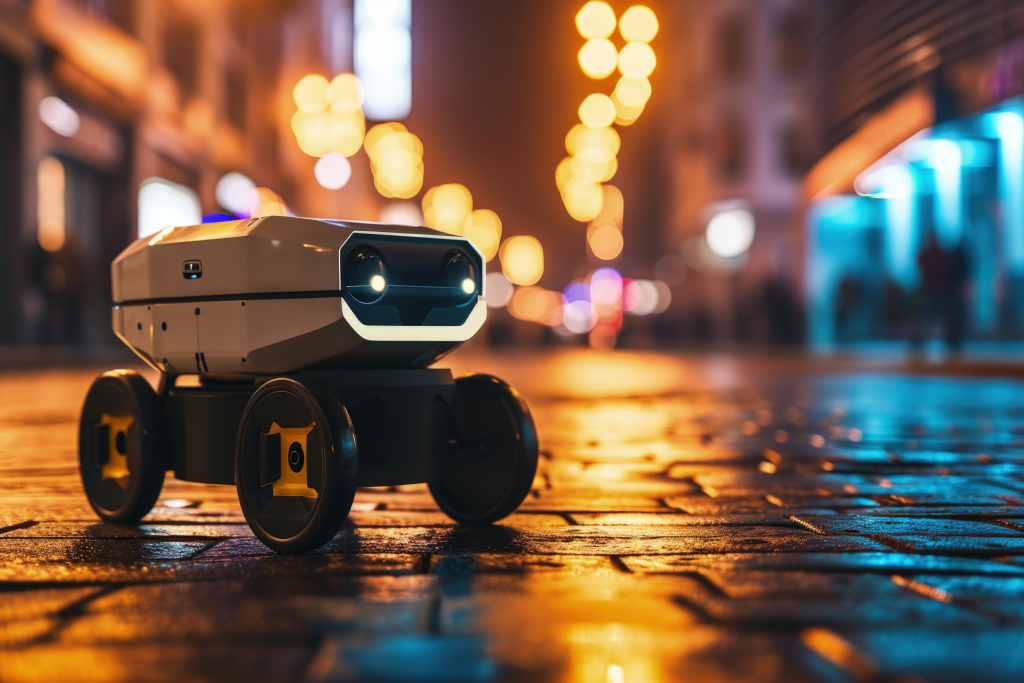
Autonomous robotics refers to a field of robotics focused on creating robots that can perceive their environment, make decisions, and execute tasks independently, without continuous human supervision or direct control. Unlike traditional automated robots that often follow pre-programmed paths or require human input for every change, autonomous robots use a combination of sensors, artificial intelligence (AI), and advanced control systems to adapt to dynamic environments and perform complex operations.
Key Characteristics of Autonomous Robotics:
- Extensive Autonomy: The defining feature. They operate with minimal to no human intervention once activated.
- Perception: Equipped with various sensors (cameras, LiDAR, radar, ultrasonic, GPS, force sensors, etc.) to gather data about their surroundings, allowing them to “see,” “hear,” and “feel” their environment.
- Intelligence (AI & ML): They leverage AI and machine learning algorithms to:
- Process and interpret sensor data: To understand their current state and the environment.
- Make decisions: To choose appropriate actions based on their goals and real-time information.
- Plan paths and movements: To navigate complex or changing environments while avoiding obstacles.
- Learn and adapt: To improve their performance over time through experience and data analysis.
- Adaptability: They can adjust their behavior in response to unforeseen changes in their environment, unlike fixed automation which struggles with deviations.
- Self-Sufficiency: Some autonomous robots can manage their own power (e.g., self-charging), perform basic self-diagnostics, and even recover from minor errors.
Autonomous vs. Automated Robots:
It’s crucial to distinguish autonomous robots from mere automated robots:
| Feature | Automated Robots | Autonomous Robots |
| Human Intervention | Requires significant human involvement (programming, monitoring, direct control). | Requires minimal to no human intervention once initialized. |
| Guidance | Follow pre-programmed instructions or physical guides (tapes, beacons). | Use sensors and AI to understand their environment and navigate independently. |
| Adaptability | Limited ability to adapt to changes; typically rigid. | Highly adaptable to dynamic and unstructured environments. |
| Decision-Making | Executes pre-defined tasks; limited real-time decision-making. | Makes real-time decisions based on perceived environment and goals. |
| Intelligence | Primarily programmed logic. | Leverages AI, machine learning, and deep learning for intelligent behavior. |
| Complexity | Generally simpler in terms of sensing and processing. | More complex with advanced sensor fusion and AI algorithms. |
| Examples | Traditional robotic arms on an assembly line performing repetitive spot welding. | Self-driving cars, warehouse AMRs, surgical robots, exploration rovers. |
Export to Sheets
Industrial Applications of Autonomous Robotics:
Autonomous robots are transforming industries by enhancing efficiency, safety, and productivity:
- Logistics and Warehousing:
- Autonomous Mobile Robots (AMRs): Used for material handling, picking, sorting, and transporting goods within warehouses and factories. They can navigate dynamically, avoid obstacles, and optimize routes without fixed infrastructure. (e.g., Amazon’s Kiva robots, GreyOrange’s solutions in India).
- Autonomous Forklifts: Operate independently to move pallets and heavy loads in distribution centers.
- Manufacturing:
- Flexible Assembly: Autonomous collaborative robots (“cobots”) work alongside humans, performing tasks like screwing, insertions, or quality checks, adapting to variations in parts or human presence.
- Machine Tending: Autonomous robots can load and unload raw materials from CNC machines or other equipment, monitor the process, and adapt to production changes.
- Quality Inspection: Robots equipped with advanced vision systems autonomously inspect products for defects, maintaining high consistency and precision.
- Painting & Welding: Autonomous systems can adapt to complex geometries and perform consistent painting or welding tasks.
- Healthcare:
- Surgical Robots: Assist surgeons with high precision, performing minimally invasive procedures (e.g., da Vinci Surgical System). Future advancements aim for greater autonomy in specific surgical steps.
- Hospital Logistics: Autonomous robots transport medicines, lab samples, and linens within hospitals.
- Patient Care: Robots can assist with patient monitoring, basic care tasks, and even rehabilitation exercises.
- Agriculture (AgriTech):
- Autonomous Tractors & Harvesters: Perform tasks like plowing, planting, spraying, and harvesting with minimal human oversight, optimizing resource use and improving yields.
- Drones for Crop Monitoring: Autonomous drones survey large fields, identify crop health issues, and optimize irrigation or pesticide application.
- Construction:
- Site Surveying & Mapping: Autonomous drones and ground robots can map construction sites, monitor progress, and inspect infrastructure.
- Material Transport: Robots can transport heavy building materials around a site.
- Automated Construction Equipment: Early stages involve autonomous bulldozers, excavators, and bricklaying robots.
- Inspection and Maintenance (Dull, Dirty, Dangerous tasks):
- Industrial Inspections: Robots like Boston Dynamics’ Spot can navigate hazardous industrial environments (e.g., oil rigs, power plants, mines) to perform inspections, detect leaks, or monitor equipment.
- Infrastructure Monitoring: Autonomous drones inspect bridges, pipelines, and power lines for damage.
- Nuclear and Hazardous Environments: Robots handle radioactive materials or operate in contaminated zones, protecting human workers.
- Defense and Security:
- Surveillance & Reconnaissance: Autonomous drones and ground vehicles for border patrol, reconnaissance missions, and monitoring.
- Explosive Ordnance Disposal (EOD): Robots handle and neutralize hazardous objects, including bombs.
Challenges of Autonomous Robotics:
Despite their immense potential, autonomous robots face several challenges:
- Technical Complexity:
- Sensor Fusion & Perception: Integrating data from multiple sensors to create a robust and accurate understanding of a dynamic, unpredictable environment.
- Robust AI/ML: Developing AI algorithms that can handle novel situations, learn continuously, and maintain reliability in varied conditions.
- Localization & Navigation: Accurately knowing its position and planning optimal paths in complex, changing environments.
- Power Management: Ensuring sufficient power for extended autonomous operations.
- Safety and Reliability:
- Ensuring foolproof operation, especially when working alongside humans (human-robot collaboration/cobots). Failures can have significant consequences.
- Validating and testing autonomous systems for every possible scenario is incredibly difficult.
- Regulatory and Ethical Concerns:
- Developing clear legal frameworks for liability in case of accidents involving autonomous robots.
- Addressing job displacement fears as robots automate more tasks.
- Ethical considerations, particularly in defense (lethal autonomous weapons) and healthcare (decision-making in critical situations).
- Data privacy and cybersecurity risks, as autonomous robots collect and transmit sensitive environmental data.
- High Initial Investment: While long-term benefits are substantial, the upfront cost of advanced autonomous robotic systems can be high.
Future of Autonomous Robotics, especially in India:
The future of autonomous robotics is bright and rapidly expanding, with India poised to play a significant role:
- Increased Integration: Expect more seamless integration of autonomous robots into daily life, from smart cities (autonomous public transport) to elder care.
- Physical AI Era: We are entering the era of “Physical AI,” where machines perceive, reason, plan, and act in the physical world with increasing sophistication.
- Democratization: As technology matures and costs decrease, autonomous robots will become accessible to smaller businesses and a wider range of applications.
- India’s Potential:
- Talent Pool: India’s vast pool of engineering graduates and strong IT/AI ecosystem provides a significant demographic advantage to develop autonomous systems.
- Market Need: Huge internal demand across manufacturing, logistics, healthcare, agriculture, and defense for automation and efficiency.
- Government Initiatives: Growing focus on AI and robotics through various missions and research grants (e.g., DRDO’s work on robots like Daksh for hazardous object detection).
- Startup Ecosystem: A vibrant startup scene is emerging, developing indigenous solutions for diverse applications like front-desk service, hospital assistance, and retail inventory management.
- Open-Source Advantage: Leveraging open-source platforms like Autoware can democratize access to advanced AV development, reducing the cost of innovation.
India has the opportunity to move from being a consumer to a significant creator and exporter of autonomous robotic solutions, especially in areas like logistics, smart farming, and specialized service robotics, tailored to its unique industrial and societal needs.
What is Autonomous Robotics?
Autonomous robotics is a branch of robotics focused on creating robots that can operate independently and intelligently in dynamic environments, without direct and continuous human supervision. The core idea is for robots to be able to perceive, understand, decide, and act on their own, adapting to changes in their surroundings.
Here’s a breakdown of what defines autonomous robotics:
1. Independent Operation (Autonomy): The most crucial characteristic. Once an autonomous robot is given a goal or mission, it should be able to execute it without a human constantly telling it what to do next. This is in contrast to traditional industrial robots that follow pre-programmed, rigid sequences of movements.
2. Perception of Environment: Autonomous robots are equipped with a variety of sensors to gather information about their surroundings. These sensors act as the robot’s “senses,” allowing it to “see,” “hear,” and “feel” its world. Common sensors include:
- Cameras: For visual perception and object recognition.
- LiDAR (Light Detection and Ranging): For creating 3D maps of the environment and detecting obstacles.
- Radar: For detecting objects and their velocity, especially in adverse weather.
- Ultrasonic Sensors: For short-range obstacle detection.
- GPS: For global positioning.
- IMUs (Inertial Measurement Units): For sensing orientation and acceleration.
- Force/Tactile Sensors: For interacting with objects and sensing contact.
3. Intelligence (AI & Machine Learning): This is the “brain” of the autonomous robot. AI and ML algorithms are used to:
- Process Sensor Data: Interpret raw sensor data into meaningful information about the environment (e.g., identifying objects, determining distances, recognizing people).
- Simultaneous Localization and Mapping (SLAM): Build a map of an unknown environment while simultaneously locating itself within that map.
- Decision-Making: Based on its goals and perceived environment, the robot makes real-time decisions on what actions to take.
- Path Planning and Navigation: Calculate the most efficient and safe path to a destination while avoiding static and dynamic obstacles.
- Learning and Adaptation: Through machine learning, autonomous robots can learn from experience, improve their performance over time, and adapt to unforeseen situations or changing conditions.
4. Adaptability: Unlike fixed automation that struggles with any deviation from its programmed routine, autonomous robots can adjust their behavior in response to changes. If an obstacle appears in its path, it can re-plan its route. If lighting conditions change, its vision system can compensate.
5. Self-Sufficiency (in some cases): Highly autonomous robots might also manage their own power (e.g., return to a charging station), perform self-diagnostics, or even recover from minor errors without human intervention.
Autonomous vs. Automated:
It’s important to differentiate:
- Automated robots simply follow pre-programmed instructions. They are excellent for repetitive tasks in controlled environments but lack the ability to react to unforeseen circumstances.
- Autonomous robots possess the intelligence to perceive their environment and make decisions on their own, allowing them to operate in more complex and unpredictable settings.
Examples of Autonomous Robots:
- Self-driving cars: Perceive the road, traffic, and pedestrians to navigate safely.
- Autonomous Mobile Robots (AMRs) in warehouses: Transport goods, navigate aisles, and avoid people and other robots without fixed tracks.
- Robotic vacuum cleaners (e.g., Roomba): Map your home, navigate around furniture, and return to their charging dock.
- Drones for inspection or delivery: Fly pre-defined missions, avoid obstacles, and land autonomously.
- Exploration rovers (e.g., Mars rovers): Navigate alien terrains, identify scientific targets, and collect data with minimal human intervention.
- Surgical robots (increasingly): While still supervised by surgeons, they offer increasing levels of autonomy for precise tasks.
In essence, autonomous robotics represents a significant leap from simple automation to intelligent, independent machine operation, paving the way for robots to operate in more complex, dynamic, and human-centric environments.
Who is require Autonomous Robotics?
Courtesy: AI IXX
Autonomous robotics is not a luxury, but an increasingly vital requirement for a wide range of industries and organizations that need to achieve:
- Higher Efficiency and Productivity: Automating repetitive, mundane, or time-consuming tasks 24/7 without breaks.
- Enhanced Safety: Removing humans from dangerous, hazardous, or physically demanding environments.
- Improved Quality and Consistency: Performing tasks with precision and repeatability that human operators cannot consistently match.
- Reduced Operational Costs: Lowering labor costs, minimizing errors and waste, and optimizing resource utilization.
- Increased Flexibility and Adaptability: Operating in dynamic and unstructured environments where traditional automation falls short.
- Addressing Labor Shortages: Filling gaps in the workforce for specific tasks that are difficult to recruit for or are undesirable.
- Scalability: Easily increasing output by deploying more autonomous units without significant overhead.
Here’s a detailed breakdown of “who” requires autonomous robotics:
1. Manufacturing Sector:
- Who: Automotive manufacturers, electronics assemblers, food and beverage processors, heavy machinery producers, aerospace companies, and any factory aiming for Industry 4.0.
- Why: For precision assembly, welding, painting, material handling (moving parts between workstations), quality inspection, and machine tending (loading/unloading machines). Autonomous mobile robots (AMRs) are crucial for flexible factory layouts, moving components without fixed guides.
- Indian Context: Companies like Tata Motors, Maruti Suzuki, Foxconn (electronics), and various FMCG manufacturers are increasingly deploying autonomous robots to improve production efficiency, reduce defects, and manage labor costs. Indian robotics companies like GreyOrange, Systemantics, and TAL Manufacturing Solutions (Tata Group) are catering to this demand.
2. Logistics and Warehousing:
- Who: E-commerce giants (e.g., Amazon, Flipkart), third-party logistics (3PL) providers, retail chains, and companies with large distribution centers.
- Why: For automated picking and packing, sorting parcels, real-time inventory management, and moving goods within warehouses. AMRs (like those from GreyOrange in India) are essential for navigating complex and changing warehouse layouts, improving order fulfillment speed, and optimizing storage space.
- Indian Context: E-commerce boom is a major driver. Companies like Flipkart, Reliance Retail, and various logistics companies are investing heavily in autonomous robots to handle increased order volumes and improve delivery efficiency.
3. Healthcare Sector:
- Who: Hospitals, clinics, pharmaceutical manufacturers, and elderly care facilities.
- Why:
- Surgical Assistance: For highly precise, minimally invasive surgeries (e.g., da Vinci surgical system, increasingly with autonomous features for specific tasks).
- Medical Logistics: Autonomous robots transport medicines, lab samples, patient records, and linens within hospitals, reducing human effort and preventing cross-contamination.
- Disinfection: UV-C light robots autonomously disinfect rooms, especially critical during pandemics.
- Patient Monitoring & Rehabilitation: Robots assist in physical therapy and provide companionship or basic monitoring.
- Pharmaceutical Manufacturing: Autonomous robots handle sensitive materials, ensure sterility, and optimize complex processes.
- Indian Context: Indian hospitals are beginning to adopt autonomous robots for delivery and disinfection. Indian startups like SurgiBotix Innovations are developing surgical robots, and Jetbrain Robotics, Rife Technologies, and Invento Robotics are deploying AMRs for hospital logistics.
4. Agriculture (AgriTech):
- Who: Large-scale farms, precision agriculture companies, and food producers.
- Why: For precision farming (planting seeds, applying fertilizers/pesticides with high accuracy), autonomous harvesting (picking fruits/vegetables), weeding, crop monitoring (using drones), and livestock management. This addresses labor shortages, optimizes resource use, and increases yields.
- Indian Context: India’s vast agricultural sector is ripe for autonomous robotics. Startups like Niqo Robotics and TartanSense are developing AI-powered robots for precision spraying and other farming applications tailored to India’s diverse crops and terrains, addressing challenges like labor scarcity and water management.
5. Infrastructure Inspection and Maintenance:
- Who: Utility companies (power, oil & gas), civil engineering firms, mining companies, and defense organizations.
- Why: For inspecting hazardous or difficult-to-reach environments (e.g., pipelines, power lines, bridges, mines, nuclear facilities) without endangering human workers. Autonomous drones and ground robots can perform routine inspections, detect anomalies, and monitor equipment condition.
- Indian Context: Organizations like DRDO are working on autonomous robots for defense applications, including hazardous object detection. Infrastructure companies are exploring drone-based autonomous inspection.
6. Defense and Security:
- Who: Military forces, border patrol, law enforcement agencies.
- Why: For reconnaissance, surveillance, explosive ordnance disposal (EOD), logistics in dangerous zones, and potentially for combat operations (though this raises significant ethical debates).
- Indian Context: DRDO is a key player in developing autonomous platforms for surveillance, reconnaissance, and bomb disposal.
7. Service Industries (Emerging):
- Who: Retail stores, hotels, restaurants, and cleaning service providers.
- Why: For tasks like shelf-scanning (inventory management), customer greeting/guidance, delivering items (e.g., room service in hotels), and autonomous cleaning/disinfection.
- Indian Context: Some upscale hotels and retail chains in metropolitan areas are experimenting with service robots for guest interaction and delivery.
In essence, any organization that faces challenges with efficiency, safety, labor availability, consistency, or the need to operate in complex/hazardous environments is increasingly requiring autonomous robotics as a core part of its operational strategy. Sources
When is require Autonomous Robotics?
Autonomous robotics isn’t required “at a specific time” in the sense of a scheduled event. Instead, its requirement arises when the current methods of operation fall short of desired levels of efficiency, safety, cost-effectiveness, or precision, particularly in dynamic and complex environments.
Here’s a breakdown of when autonomous robotics becomes a requirement, defined by the challenges it solves:
1. When Operations are Too Slow or Inefficient:
- When: In industries with high throughput demands, repetitive tasks, or processes that require continuous operation (24/7). This includes manufacturing lines, large warehouses, and logistics hubs.
- Why Autonomous Robotics is Required: Autonomous robots can work tirelessly, at a consistent speed and precision, without breaks, fatigue, or human error. This dramatically increases throughput, optimizes workflows, and allows businesses to scale operations efficiently.
- Example: Autonomous Mobile Robots (AMRs) in warehouses are required when e-commerce demands lead to overwhelming order volumes that manual labor or traditional conveyors cannot handle.
2. When Tasks are Dangerous, Hazardous, or Physically Demanding:
- When: In environments that pose risks to human life or health, such as nuclear power plants, chemical factories, mines, disaster zones, or spaces with extreme temperatures, toxic substances, or unstable structures. Also, for tasks involving heavy lifting, repetitive strain, or working at heights.
- Why Autonomous Robotics is Required: Robots can operate in conditions too dangerous for humans, keeping workers safe and reducing workplace injuries. They can also perform physically taxing jobs without succumbing to fatigue or injury.
- Example: Autonomous inspection robots (like Boston Dynamics’ Spot) are required to monitor pipelines in hazardous oil and gas facilities, reducing the need for human inspectors to enter potentially volatile areas.
3. When Precision, Consistency, and Quality are Paramount:
- When: In industries where even minor human errors can lead to significant defects, waste, or safety issues, such as high-tech manufacturing, medical device production, or delicate surgical procedures.
- Why Autonomous Robotics is Required: Robots deliver unparalleled precision and repeatability, ensuring consistent product quality and reducing defects. Their sensor systems and AI allow for meticulous execution of tasks like intricate assembly, precise welding, or quality inspection.
- Example: Autonomous robotic arms are required in electronics manufacturing for placing tiny components with extreme accuracy, far exceeding human capability.
4. When Labor Shortages or High Labor Costs are a Challenge:
- When: In regions experiencing demographic shifts leading to a shrinking workforce, or for undesirable jobs that are difficult to fill, or when labor costs significantly impact competitiveness.
- Why Autonomous Robotics is Required: Robots can augment or replace human labor for specific tasks, addressing workforce gaps and reducing operational expenses in the long run, despite initial investment costs.
- Example: Autonomous harvesting robots are required in agriculture when seasonal labor for picking crops becomes scarce or prohibitively expensive.
5. When Flexibility and Adaptability in Dynamic Environments are Needed:
- When: In environments that are not static or perfectly structured, where obstacles appear, layouts change, or tasks need to be reconfigured on the fly. This is common in modern flexible manufacturing, logistics, and service industries.
- Why Autonomous Robotics is Required: Unlike rigid, pre-programmed automation, autonomous robots use sensors and AI to perceive their environment and adapt their behavior in real-time. They can navigate around unexpected obstacles, adjust to changing production demands, or reroute themselves based on live conditions.
- Example: Autonomous mobile robots (AMRs) are required in modern warehouses that frequently reconfigure their layouts or experience fluctuating inventory levels, as they can adapt without needing expensive infrastructure changes.
6. When Data Collection and Analysis for Optimization are Crucial:
- When: In operations where continuous monitoring, precise data collection, and real-time insights are vital for ongoing improvement and decision-making.
- Why Autonomous Robotics is Required: Autonomous robots can gather vast amounts of data about their environment and operations. This data, combined with AI, can be used to identify bottlenecks, predict maintenance needs, optimize processes, and drive continuous improvement.
- Example: Autonomous drones for crop monitoring are required in agriculture to collect precise data on plant health, soil conditions, and pest infestations, enabling data-driven decisions for optimizing yields.
In summary, autonomous robotics becomes a strategic imperative when organizations aim to move beyond the limitations of manual labor and traditional automation, seeking to unlock new levels of performance, safety, and adaptability in complex and evolving operational landscapes. It’s about moving from doing things “better” to doing them “intelligently and independently.” Sources
Where is require Autonomous Robotics?
Autonomous robotics is required across a wide spectrum of industries and environments where current methods are insufficient in terms of safety, efficiency, precision, or labor availability. Its application is truly global and rapidly expanding, as organizations seek to automate complex, dynamic, and often hazardous tasks.
Here’s a breakdown of where autonomous robotics is required, with a particular focus on the Indian context:
1. Manufacturing Facilities (India & Global):
- Where: Automotive assembly lines, electronics manufacturing plants, food and beverage processing units, heavy machinery production, and any factory aiming for Industry 4.0.
- Why: Autonomous Mobile Robots (AMRs) are crucial for material handling (moving parts between workstations, bringing raw materials to production lines), improving intralogistics efficiency, and enabling flexible factory layouts without fixed infrastructure. Autonomous robotic arms are required for precision tasks like welding, painting, assembly, and quality inspection, ensuring consistent quality and reducing human error.
- Indian Context: Major players like Tata Motors, Maruti Suzuki, and various electronics and FMCG manufacturers are increasingly adopting AMRs and autonomous robotic arms to enhance productivity and competitiveness. Indian robotics companies like GreyOrange, Addverb, and Systemantics are key providers in this space, with solutions for diverse manufacturing needs.
2. Warehouses and Logistics Hubs (India & Global):
- Where: E-commerce fulfillment centers, large distribution centers, third-party logistics (3PL) warehouses, and retail back-of-store operations.
- Why: Autonomous robots (especially AMRs for picking, sorting, and transporting goods) are required to handle the immense volume and speed demanded by e-commerce, optimize inventory management, improve order fulfillment accuracy, and address labor shortages during peak seasons. They navigate complex and changing environments, avoiding obstacles and optimizing routes.
- Indian Context: The booming e-commerce sector (e.g., Flipkart, Amazon India, Reliance Retail) is a primary driver. GreyOrange and Addverb Technologies are prominent Indian companies offering advanced warehouse automation solutions, including AMRs, that are being deployed across the country.
3. Healthcare Facilities (India & Global):
- Where: Hospitals, clinics, laboratories, and pharmaceutical manufacturing facilities.
- Why:
- Logistics: Autonomous robots transport medicines, lab samples, medical supplies, and even food/linens within hospitals, reducing human effort, improving efficiency, and minimizing contamination risks.
- Disinfection: Autonomous UV-C light robots are required for sanitizing patient rooms and operating theaters, especially critical for infection control.
- Surgical Assistance: While still under human supervision, advanced surgical robots (e.g., da Vinci system) offer increasing levels of autonomy for precise manipulations, enhancing surgical outcomes and reducing invasiveness.
- Pharmaceutical Manufacturing: Autonomous robots handle sensitive materials, ensure sterility, and optimize complex drug production processes.
- Indian Context: Many large hospitals in major Indian cities are beginning to deploy autonomous robots for delivery and disinfection. Indian startups like SurgiBotix Innovations are developing surgical robots, and companies like Rife Technologies and Invento Robotics are providing AMRs for hospital logistics.
4. Agriculture (India & Global):
- Where: Large-scale farms, greenhouses, vineyards, and agricultural research centers.
- Why: Autonomous farm robots (AgriBots) are required for precision farming tasks like planting, weeding, spraying pesticides/fertilizers (targeted application), harvesting, and crop monitoring (using drones). This addresses labor shortages, optimizes resource use (water, chemicals), reduces environmental impact, and improves crop yields.
- Indian Context: With a significant agricultural sector facing labor challenges and a need for improved efficiency, Niqo Robotics, TartanSense, and XMachines are Indian startups developing AI-powered autonomous robots for precision spraying, weeding, and other farming applications tailored to Indian conditions. Drones are increasingly used for autonomous crop health monitoring.
5. Hazardous and Remote Environments:
- Where: Mining sites, oil and gas platforms, nuclear power plants, disaster zones, deep-sea exploration, and space exploration.
- Why: Autonomous robots are required to perform inspections, maintenance, data collection, and even operations in environments too dangerous, remote, or inaccessible for humans, ensuring worker safety and continuity of operations.
- Indian Context: DRDO (Defence Research and Development Organisation) is actively involved in developing autonomous robotic platforms for defense applications, including handling hazardous materials (like DAKSHA for bomb disposal) and reconnaissance in hostile territories. Mining companies are also exploring autonomous drilling and inspection.
6. Defense and Security (India & Global):
- Where: Borders, surveillance zones, military bases, and conflict areas.
- Why: Autonomous drones (UAVs), unmanned ground vehicles (UGVs), and autonomous underwater vehicles (AUVs) are required for reconnaissance, surveillance, logistics, demining, and potentially for combat roles (with ongoing ethical debates). They reduce risk to human personnel and enhance situational awareness.
- Indian Context: DRDO’s Centre for Artificial Intelligence & Robotics (CAIR) is a premier lab focusing on developing AI and robotics for defense applications, including autonomous navigation systems and search robots.
7. Service Industries (Emerging):
- Where: Retail stores, hotels, restaurants, cleaning services, and public spaces.
- Why: Autonomous robots are increasingly required for tasks like inventory scanning, customer greeting and guidance, food delivery, room service, and automated cleaning (e.g., floor scrubbers).
- Indian Context: While still in nascent stages, some upscale hotels and restaurants in metros are experimenting with service and delivery robots.
In summary, autonomous robotics is required wherever there’s a compelling need to transcend human limitations (safety, endurance, precision, speed) and where environments are too complex or dynamic for traditional, rigid automation. Its applications are constantly expanding as the technology matures and becomes more accessible.
How is require Autonomous Robotics?
Autonomous robotics isn’t “required” in a single, simple way. Instead, its necessity arises from a confluence of factors that make traditional methods inadequate or suboptimal. The “how” it’s required refers to the mechanisms through which autonomous robots deliver value and solve critical industrial and societal problems.
Here’s how autonomous robotics is required across various domains:
1. By Maximizing Efficiency and Productivity:
- How it’s Required: Autonomous robots are needed to perform repetitive, mundane, or physically demanding tasks 24/7 without fatigue, breaks, or human error. They can operate at consistent speeds and with high precision, significantly increasing throughput and optimizing workflows.
- Mechanism:
- Continuous Operation: Unlike human workers who require shifts and breaks, autonomous robots can work around the clock.
- Optimized Path Planning: AI-driven navigation allows Autonomous Mobile Robots (AMRs) to find the most efficient routes in dynamic environments, reducing travel time and bottlenecks.
- Eliminating Bottlenecks: By automating the movement of goods or components, they ensure a smooth, uninterrupted flow in factories and warehouses.
- Example: In an e-commerce fulfillment center, AMRs are required to autonomously retrieve items from shelves and bring them to packing stations. This allows the center to process thousands of orders per hour, a rate impossible with manual labor, directly impacting delivery speed and customer satisfaction.
2. By Enhancing Safety in Hazardous Environments:
- How it’s Required: Autonomous robots are essential for taking humans out of dangerous, dirty, or dull (3D) tasks and environments.
- Mechanism:
- Remote Operation & Autonomy: Robots can operate in areas with toxic chemicals, extreme temperatures, radiation, unstable structures, or where there’s a risk of explosion.
- Sensor-Based Awareness: Equipped with advanced sensors (LiDAR, thermal cameras, gas detectors), they can detect hazards and navigate safely without human intervention in real-time.
- Pre-emptive Inspection: They can perform routine inspections in hazardous areas, identifying potential issues before they become critical and without putting human lives at risk.
- Example: In nuclear power plants, autonomous inspection robots are required to monitor radiation levels and check for equipment faults, preventing human exposure to harmful radiation. In mining, autonomous drilling and hauling vehicles reduce the risk of accidents from rockfalls or heavy machinery.
3. By Ensuring Unparalleled Precision and Quality:
- How it’s Required: When tasks demand micron-level accuracy and absolute consistency that human hands cannot reliably achieve.
- Mechanism:
- Automated Precision: Robotic arms can perform intricate assembly, welding, or machining tasks with exact repeatability, eliminating human variability.
- Advanced Vision Systems: AI-powered cameras allow robots to perform highly accurate quality checks, identifying defects that might be missed by the human eye.
- Consistent Output: They ensure every product meets the exact same specifications, leading to fewer defects, less rework, and reduced waste.
- Example: In semiconductor manufacturing, autonomous robots are required to handle and assemble microchips with extreme precision in cleanroom environments, where human contact could cause contamination or damage.
4. By Addressing Labor Shortages and Workforce Challenges:
- How it’s Required: In industries struggling to find sufficient labor for repetitive, low-skill, or physically demanding jobs, or when labor costs are becoming unsustainable.
- Mechanism:
- Automation of Mundane Tasks: Robots take over tasks that humans find undesirable, freeing up human workers for more complex, strategic, or creative roles.
- Augmenting Human Capabilities: Collaborative autonomous robots (cobots) can work alongside humans, assisting with heavy lifting or repetitive actions, thereby increasing human productivity and reducing physical strain.
- Filling Labor Gaps: In sectors like agriculture or logistics facing seasonal or persistent labor shortages, autonomous robots provide a reliable workforce.
- Example: In modern warehouses, the demand for fast fulfillment outstrips the available human workforce. AMRs are required to fill this gap, taking on the monotonous task of moving goods so human workers can focus on higher-value tasks like complex picking or quality control.
5. By Enabling Flexibility and Adaptability in Dynamic Environments:
- How it’s Required: In environments that are not rigidly structured or constantly changing, where traditional fixed automation is impractical.
- Mechanism:
- Real-time Perception and Navigation: Autonomous robots use sensors and AI (SLAM technology) to understand their environment, build maps, localize themselves, and plan paths dynamically.
- Obstacle Avoidance: They can detect and navigate around unforeseen obstacles (e.g., a person, a dropped box, a temporary setup change) without requiring reprogramming.
- Dynamic Task Reconfiguration: Some autonomous systems can be quickly reprogrammed or even learn new tasks on the fly, allowing for rapid adaptation to changing production needs or operational requirements.
- Example: An autonomous cleaning robot in a public mall is required because the environment (people, furniture, spills) is constantly changing. It needs to autonomously navigate, avoid obstacles, and clean effectively without human guidance.
In summary, autonomous robotics is required as a fundamental strategic tool to overcome the inherent limitations of human capabilities and traditional automation, thereby unlocking new levels of performance, safety, and operational resilience across diverse industrial and service sectors. Sources
Case study on Autonomous Robotics?
Courtesy: CNET
Autonomous robotics is a burgeoning field, and while full-scale, long-term case studies are still emerging due to its relative novelty and the proprietary nature of industrial implementations, several prominent examples demonstrate its impact.
Here’s a case study that highlights the industrial application of autonomous robotics, particularly in the context of India:
Case Study: Addverb Technologies and the Automation of a Large Retailer’s Warehouse in India
Company/Solution Provider: Addverb Technologies (an Indian company, now a subsidiary of Reliance Retail)
Client: A major Indian retail giant (often cited as Reliance Retail’s own warehousing operations, given Addverb’s acquisition by Reliance).
The Challenge:
The rapidly expanding e-commerce and retail landscape in India presented significant challenges for large retailers:
- Massive Order Volumes: Handling millions of orders daily, with fluctuating demand (especially during festive seasons).
- Speed and Accuracy: Customers expect extremely fast deliveries and error-free order fulfillment.
- Labor Intensive: Traditional manual warehouses are highly dependent on human labor for picking, packing, and sorting, leading to:
- High Operational Costs: Wages, training, and managing a large workforce.
- Labor Shortages: Difficulty in finding and retaining sufficient skilled labor, especially during peak seasons.
- Human Error: Inefficiencies, incorrect picks, and damage during manual handling.
- Space Utilization: Inefficient use of vertical space due to manual access limitations.
- Scalability: Difficulty in rapidly scaling operations up or down to meet fluctuating demand.
Addverb’s Autonomous Robotics Solution:
Addverb Technologies deployed a comprehensive suite of autonomous robotic solutions to transform the retailer’s large-scale fulfillment centers. The solution typically involves a combination of:
- Autonomous Mobile Robots (AMRs):
- Application: Fleets of AMRs (e.g., Addverb’s “Quark” or “Veloce” series) were deployed to autonomously navigate the warehouse floor, transporting inventory shelves to picking stations (Goods-to-Person system) or moving finished orders to shipping docks.
- Autonomous Capabilities: These robots use SLAM (Simultaneous Localization and Mapping) technology, LiDAR, and other sensors to perceive their environment, avoid obstacles (including human workers and other robots), and dynamically re-plan routes in real-time. They operate without fixed tracks or magnetic tapes.
- Robotic Picking Systems (Collaborative Robots/Robotic Arms):
- Application: While AMRs move shelves, collaborative robotic arms (often equipped with AI-driven vision systems) are used for precise picking and placing of items from shelves into order bins.
- Autonomous Capabilities: These robots can identify diverse product shapes and sizes, grasp them gently, and place them accurately, reducing manual picking errors and improving efficiency. They work safely alongside human operators.
- Automated Storage and Retrieval Systems (AS/RS) with Autonomous Components:
- Application: High-density storage systems that use autonomous shuttles or cranes to store and retrieve inventory vertically, maximizing warehouse space utilization.
- Autonomous Capabilities: The shuttles or mini-load cranes operate autonomously within the racking system, retrieving specific SKUs as directed by the Warehouse Management System (WMS).
- AI-Powered Fleet Management System (FMS):
- Application: A central software system that orchestrates the entire fleet of autonomous robots.
- Autonomous Capabilities: The FMS autonomously assigns tasks to robots, optimizes their routes, manages battery charging (sending robots to charging stations when needed), balances workload, and provides real-time monitoring and reporting. It makes intelligent decisions to ensure smooth and efficient operation of the entire robotic fleet.
Measurable Outcomes and Impact:
The deployment of Addverb’s autonomous robotics solutions led to significant improvements for the retail giant:
- Dramatic Increase in Throughput: Order processing capacity increased by 3-5 times compared to manual operations, allowing the retailer to handle peak season demand (like Diwali sales) effectively.
- Significant Reduction in Errors: Automation, especially robotic picking and smart sorting, drastically reduced picking and packing errors, leading to higher order accuracy and improved customer satisfaction.
- Optimized Space Utilization: AS/RS and AMR-based systems allowed for much higher-density storage, reducing the overall warehousing footprint required for a given volume of inventory.
- Enhanced Operational Efficiency: Faster cycle times, reduced manual intervention, and optimized material flow led to substantial gains in overall operational efficiency.
- Reduced Labor Dependency: While not eliminating jobs, the robots handled the most repetitive and physically demanding tasks, allowing human workers to be redeployed to higher-value activities or mitigating labor shortage challenges.
- Improved Safety: Less human movement within the warehouse reduces the risk of accidents.
- Faster Go-to-Market: The increased efficiency in order fulfillment translated directly into faster delivery times for customers, a critical competitive advantage in the e-commerce sector.
Significance of the Case Study (Especially in India):
This case study is highly significant because:
- Indian Innovation: It showcases an Indian company (Addverb) providing cutting-edge autonomous robotics solutions, demonstrating India’s growing capabilities in advanced automation.
- Addressing E-commerce Demand: It directly addresses the explosive growth of e-commerce in India, where traditional methods are simply unsustainable for the volumes involved.
- Real-World Scalability: It proves that autonomous robotics solutions can be successfully implemented and scaled in large, complex industrial environments.
- Holistic Approach: It highlights the integration of various autonomous robotic systems (AMRs, robotic arms, AS/RS) orchestrated by intelligent software, representing a comprehensive automation strategy.
- Blueprint for Others: It serves as a strong case study for other large retailers and logistics providers in India and globally, demonstrating the tangible benefits of investing in autonomous robotics.
This example illustrates how autonomous robotics is transforming the entire workflow of an industry, making it more efficient, responsive, and resilient to market demands.
White paper on Autonomous Robotics?
White Paper: Autonomous Robotics – Powering India’s Leap into the Future of Industry and Society
Executive Summary
The global landscape is undergoing a profound transformation driven by automation, with autonomous robotics at its forefront. Unlike traditional automated systems, autonomous robots possess the intelligence to perceive, understand, decide, and act independently in dynamic environments, revolutionizing efficiency, safety, and productivity across diverse sectors. India, with its ambitious economic goals and burgeoning technological landscape, stands at a critical juncture to harness this technology. This white paper explores the definition, core capabilities, critical applications, and the transformative impact of autonomous robotics, particularly within the Indian context. It also addresses the inherent challenges and outlines strategic imperatives for India to emerge as a global leader in the development and deployment of autonomous robotic solutions.
1. Defining Autonomous Robotics: Beyond Automation
Autonomous robotics refers to the design, development, and deployment of robotic systems capable of operating without continuous human supervision. Key differentiating characteristics from mere automation include:
- Self-Perception: Utilizing a suite of sensors (LiDAR, cameras, radar, GPS, IMUs, force sensors) to gather real-time data about their internal state and external environment.
- Environmental Understanding: Processing sensor data through Artificial Intelligence (AI) and Machine Learning (ML) algorithms to build a coherent understanding of their surroundings, including obstacle detection, object recognition, and simultaneous localization and mapping (SLAM).
- Intelligent Decision-Making: Leveraging AI/ML to plan paths, allocate resources, adapt to unforeseen circumstances, and make real-time choices to achieve defined goals.
- Independent Action: Executing tasks and navigating complex environments autonomously, without needing pre-programmed, fixed pathways or constant human intervention.
- Adaptability and Learning: The ability to adjust behavior based on new data or changing conditions, and to learn from experience to improve performance over time.
This fundamental shift from rigid programming to intelligent autonomy unlocks new possibilities for efficiency and safety across previously intractable challenges.
2. Core Technologies Enabling Autonomy
The capabilities of autonomous robots are built upon the convergence of several advanced technologies:
- Artificial Intelligence (AI) & Machine Learning (ML): The “brain” of autonomous robots, powering perception, decision-making, planning, and learning. This includes deep learning for computer vision, reinforcement learning for optimal control, and predictive analytics.
- Advanced Sensing & Sensor Fusion: Integrating data from multiple heterogeneous sensors (e.g., LiDAR, radar, cameras, ultrasonic) to create a robust and redundant understanding of the environment, crucial for safe navigation and interaction.
- Robotics Operating System (ROS): A flexible framework for writing robot software, providing tools and libraries for sensing, navigation, manipulation, and control.
- Computational Power & Edge Computing: High-performance processors and specialized hardware (GPUs, NPUs) are essential for real-time processing of vast sensor data. Edge computing enables faster decision-making by processing data closer to the source.
- Connectivity (5G, IoT): High-bandwidth, low-latency communication networks (like 5G) are crucial for cloud-based AI processing, fleet management, and real-time data exchange in large-scale deployments.
- Advanced Actuation & Control Systems: Precision motors, sophisticated manipulators, and robust control algorithms enable smooth, accurate, and safe physical interaction with the environment.
3. Critical Industrial Applications of Autonomous Robotics
Autonomous robotics is no longer a niche technology; it is becoming a core requirement across industries seeking to optimize operations:
- Logistics & Warehousing:
- Application: Autonomous Mobile Robots (AMRs) for goods-to-person picking, automated sorting, and material transport within warehouses. Autonomous forklifts.
- Impact: Dramatically increased throughput (3-5x or more), reduced human error in order fulfillment, optimized storage density, and significant labor cost savings. Critical for handling the surge in e-commerce demand.
- Manufacturing:
- Application: Autonomous robotic arms for precision assembly, welding, painting, and quality inspection. AMRs for flexible material handling on the factory floor, adapting to dynamic layouts.
- Impact: Enhanced product quality and consistency, reduced waste, increased production flexibility, and improved worker safety by automating hazardous or repetitive tasks. A cornerstone of “smart factories” (Industry 4.0).
- Healthcare:
- Application: Autonomous robots for transporting medicines, lab samples, and linens within hospitals. Autonomous UV-C disinfection robots. Surgical robots with increasing autonomy for precise tasks.
- Impact: Improved operational efficiency in hospitals, reduced risk of infection transmission, freeing up medical staff for patient care, and enhancing precision in surgical procedures.
- Agriculture (AgriTech):
- Application: Autonomous tractors for planting, spraying, and harvesting. Robotic weeders. Autonomous drones for crop monitoring and precision pesticide/fertilizer application.
- Impact: Addressing rural labor shortages, optimizing resource usage (water, chemicals), increasing crop yields, and enabling sustainable farming practices through data-driven decisions.
- Hazardous & Remote Environments:
- Application: Autonomous inspection robots for pipelines, power lines, mines, nuclear facilities, and disaster zones. Robots for explosive ordnance disposal (EOD).
- Impact: Protecting human lives by removing them from dangerous situations, enabling continuous monitoring in inaccessible areas, and improving emergency response capabilities.
- Defense & Security:
- Application: Autonomous Unmanned Aerial Vehicles (UAVs) for reconnaissance and surveillance. Unmanned Ground Vehicles (UGVs) for logistics and hazardous material handling.
- Impact: Enhancing situational awareness, reducing risk to military personnel, and improving operational effectiveness in diverse terrains.
4. The Transformative Impact: Quantifiable Benefits
The requirement for autonomous robotics is driven by its demonstrable benefits:
- Cost Reduction: Savings on labor, reduced waste from errors, optimized energy consumption, and lower insurance premiums due to improved safety.
- Time Savings: Accelerating processes by operating 24/7, optimizing workflows, and reducing idle times. Lead times for product delivery can be significantly shortened.
- Increased Productivity: Higher throughput, consistent performance, and the ability to handle larger volumes of work than human-centric operations.
- Enhanced Safety: A dramatic reduction in workplace accidents and exposure to hazardous conditions.
- Improved Quality & Consistency: Eliminating human variability leads to higher precision and fewer defects, improving overall product quality and customer satisfaction.
- Scalability & Flexibility: The ability to rapidly scale operations up or down in response to demand fluctuations, and adapt to changing production needs or environmental conditions.
5. Challenges in Adoption, Particularly for India
While the benefits are clear, the widespread adoption of autonomous robotics, especially in India, faces several challenges:
- High Initial Investment: The capital expenditure for advanced autonomous systems can be substantial, particularly for Small and Medium-sized Enterprises (SMEs).
- Data Availability and Quality: Autonomous robots rely on vast amounts of high-quality, labeled data for training AI models. Data collection, standardization, and privacy are key hurdles.
- Skilled Workforce Shortage: A significant gap exists in the availability of professionals skilled in robotics, AI, data science, and mechatronics to design, deploy, and maintain these complex systems.
- Integration Complexity: Integrating new autonomous systems with legacy IT infrastructure (e.g., Warehouse Management Systems, Manufacturing Execution Systems) can be challenging.
- Regulatory & Ethical Frameworks: Evolving regulations for liability, safety standards, and ethical considerations (e.g., job displacement, decision-making in critical situations) need to be established and matured.
- Technological Maturity: While rapidly advancing, some autonomous capabilities (e.g., human-level dexterity, robust navigation in highly unstructured environments) are still under active research.
- Supply Chain Dependence: India still relies on imports for many critical robotic components (sensors, high-precision actuators), increasing costs and potential vulnerabilities.
- Social Acceptance & Fear of Job Displacement: A significant concern, especially in a labor-abundant country like India, requiring careful management, reskilling initiatives, and focus on job augmentation rather than pure replacement.
6. India’s Strategic Imperatives for Autonomous Robotics Leadership
India is uniquely positioned to become a global hub for autonomous robotics, leveraging its strengths and addressing its challenges:
- National Strategy Implementation: Vigorous implementation of the Draft National Strategy on Robotics (released by MeitY), focusing on the identified priority sectors (Manufacturing, Agriculture, Healthcare, National Security) and the establishment of a “National Robotics Mission.”
- Talent Development & Skilling: Massive investment in STEM education, specialized robotics and AI courses at all levels, and vocational training programs to create a skilled workforce for development, deployment, and maintenance. Initiatives like Council For Robotics & Automation’s Robotics Literacy Program (RLP) are crucial.
- R&D and Innovation Ecosystem: Foster world-class research in core autonomous technologies (AI, advanced sensors, control systems). Create government-funded Centers of Excellence, encourage university-industry collaboration, and provide strong incentives for robotics startups (e.g., through incubators, accelerators, and venture capital).
- “Make in India” for Components: Reduce reliance on imports by promoting indigenous manufacturing of critical robotic components and sub-systems, building a robust domestic supply chain.
- Pilot Projects & Demonstrations: Encourage pilot projects in various industries to showcase the benefits of autonomous robotics, build confidence, and accelerate adoption, especially among SMEs.
- Regulatory Clarity & Safety Standards: Develop clear, agile, and internationally harmonized regulatory frameworks and safety standards for the deployment of autonomous robots in diverse applications.
- Data Infrastructure & Access: Build secure, interoperable, and ethically governed data infrastructure to provide the necessary fuel for AI model training.
- Public Awareness & Acceptance: Implement programs to educate the public about the benefits of robotics, addressing fears of job displacement through re-skilling and highlighting opportunities for higher-value jobs.
Conclusion
Autonomous robotics is not just a technological advancement; it is a fundamental shift in how industries operate and how societies function. For India, embracing this revolution is essential for achieving its vision of being a global economic powerhouse. By strategically investing in talent, R&D, infrastructure, and a supportive policy environment, India can not only overcome existing challenges but also cement its position as a leader in the development and deployment of autonomous robots, driving unparalleled efficiency, safety, and prosperity for its citizens.
Industrial Application of Autonomous Robotics?
Autonomous robotics is no longer a futuristic concept; it’s a rapidly evolving field with tangible, widespread applications across various industries. These applications are driven by the robots’ ability to perform tasks with higher efficiency, greater safety, enhanced precision, and reduced labor dependency, especially in dynamic and complex environments.
Here’s a detailed look at the industrial applications of autonomous robotics:
1. Manufacturing (Smart Factories / Industry 4.0):
- Autonomous Mobile Robots (AMRs):
- Application: Transporting raw materials, work-in-progress components, and finished goods between workstations, warehouses, and loading docks within a factory. They navigate autonomously, avoiding obstacles and optimizing routes in real-time.
- Examples: Automating “milk runs” (delivery of materials to production lines), moving heavy parts, or delivering tools. Companies like GreyOrange and Addverb Technologies (Indian companies) deploy AMRs in factories for efficient intralogistics.
- Autonomous Robotic Arms:
- Application: Performing tasks like precision assembly (e.g., electronics, automotive parts), welding (spot, arc, laser), painting, machine tending (loading/unloading CNC machines or presses), and quality inspection (using advanced vision systems).
- Examples: In automotive plants, autonomous robots perform repetitive welding tasks with extreme accuracy. In electronics, they pick and place tiny components onto circuit boards. In India, companies like Tata Motors and Maruti Suzuki extensively use robotic arms on their assembly lines, increasingly with autonomous features for more flexible operations.
- Collaborative Robots (Cobots): While often human-supervised, increasingly incorporate autonomous features to work safely alongside humans, adapting to their presence and movements for tasks like assistance in lifting, screwing, or polishing.
2. Logistics and Warehousing:
- Autonomous Mobile Robots (AMRs):
- Application: The backbone of modern warehouses. They move shelves to picking stations (goods-to-person systems), transport items from receiving to storage, or move packed orders to shipping. They dynamically navigate aisles, optimize routes, and manage traffic flow.
- Examples: Amazon’s fulfillment centers extensively use AMRs. In India, Addverb Technologies and GreyOrange are leading providers, deploying their AMR fleets in warehouses for major e-commerce players like Reliance Retail and Flipkart to handle massive order volumes and improve delivery speeds.
- Autonomous Sorting Systems: Robots identify and sort parcels or items based on destination, size, or type, drastically increasing sorting speed and accuracy.
- Automated Storage and Retrieval Systems (AS/RS): While AS/RS have existed, autonomous shuttles and cranes within these systems handle high-density storage and retrieval of inventory, maximizing warehouse space and efficiency.
3. Healthcare:
- Hospital Logistics Robots:
- Application: Autonomous robots transport medicines, lab samples, patient records, food, and linens within hospitals, reducing manual labor, improving efficiency, and minimizing the risk of cross-contamination.
- Examples: Hospitals in major Indian cities are adopting these robots. Companies like Rife Technologies and Jetbrain Robotics offer autonomous delivery and disinfection robots for the healthcare sector in India.
- Disinfection Robots:
- Application: Autonomous robots equipped with UV-C light or disinfectant spray navigate hospital rooms, operating theaters, and public areas to disinfect surfaces, enhancing hygiene and infection control.
- Examples: Widely used during and post-COVID-19 pandemic to ensure sterile environments.
- Surgical Robots (with increasing autonomy):
- Application: While still primarily tele-operated, these robots have autonomous features for precise manipulations, tremor filtering, and instrument control during minimally invasive surgeries. Future advancements aim for more autonomous execution of specific surgical steps.
- Examples: The da Vinci Surgical System. In India, startups like SurgiBotix Innovations are working on developing surgical robotic systems.
4. Agriculture (AgriTech):
- Autonomous Tractors and Harvesters:
- Application: Performing tasks like plowing, planting, spraying (precision application), weeding, and harvesting crops with minimal human supervision.
- Examples: Companies like John Deere are developing fully autonomous tractors. In India, startups like Niqo Robotics are developing AI-powered autonomous robots for precision spraying and weeding, tailored to India’s diverse crop types and landholdings, addressing labor shortages and optimizing resource use.
- Autonomous Drones for Crop Monitoring:
- Application: Drones autonomously fly over large fields, collecting data on crop health, soil conditions, and pest infestations. AI analyzes this data to provide actionable insights for farmers.
- Robotic Weeders/Sprayers: Robots use computer vision to differentiate between crops and weeds, then precisely remove weeds (mechanically or with lasers) or apply targeted pesticides, reducing chemical usage.
5. Hazardous and Remote Environments (Inspection & Maintenance):
- Industrial Inspection Robots:
- Application: Autonomous ground robots (like Boston Dynamics’ Spot) and drones are used to inspect critical infrastructure (e.g., oil and gas pipelines, power lines, bridges, wind turbines, nuclear facilities) for damage, leaks, or anomalies, eliminating the need for human workers in dangerous areas.
- Examples: Deploying robots to inspect offshore oil rigs or confined spaces in chemical plants.
- Mining Robots:
- Application: Autonomous drilling machines, haul trucks, and rock breakers operate in underground mines, improving safety by reducing human presence in hazardous zones and increasing efficiency.
- Explosive Ordnance Disposal (EOD) Robots:
- Application: Autonomous robots are deployed to remotely locate, identify, and neutralize bombs or other hazardous devices, protecting human bomb disposal experts. DRDO in India develops robots like DAKSHA for such tasks.
6. Defense and Security:
- Unmanned Aerial Vehicles (UAVs – Drones):
- Application: Autonomous drones conduct surveillance, reconnaissance, border patrol, and target acquisition missions.
- Unmanned Ground Vehicles (UGVs):
- Application: Autonomous UGVs are used for logistics in dangerous areas, carrying supplies, or for patrolling secure perimeters.
- Autonomous Underwater Vehicles (AUVs):
- Application: For underwater surveillance, mine countermeasures, and oceanographic research.
7. Service Industries:
- Cleaning Robots:
- Application: Autonomous floor scrubbers and vacuum cleaners operate in large commercial spaces (malls, airports, offices, hospitals) without human intervention.
- Hospitality/Retail Service Robots:
- Application: Robots for delivering food in restaurants, room service in hotels, or guiding customers and providing information in retail stores.
- Examples: Some hotels in major Indian cities are experimenting with autonomous service robots for room delivery.
These industrial applications underscore that autonomous robotics is a key enabler for industries to achieve unprecedented levels of productivity, safety, and resilience in an increasingly competitive and complex global economy.
References
- ^ Incorporation date 10 October 2002
- ^ Whitehead, Tony, “Neither Fish Nor Fowl”, Business Link South West Interview, April 2008
- ^ Directors
- ^ “Exploring Oceans, Waterways, Pipelines and Structures with Energy Efficient Robots”, 13 February 2006, www.goscience.co.uk accessed 13 April 2012
- ^ Track record – deals in 2008 Archived 1 February 2014 at the Wayback Machine
- ^ Investor’s Champion – Thalassa Holdings 20130924, 24 September 2013
- ^ Shell Technology Ventures Fund Archived 5 January 2014 at the Wayback Machine
- ^ Page, Lewis,“‘Ring-wing’ robo-sub smart swarm lands £6m oil deal”, The Register, 9 September 2009
- ^ Duey, Rhonda,“‘Flying’ Nodes Shift Marine Seismic Paradigm” Archived 1 February 2014 at the Wayback Machine, E&P Magazine, 1 December 2011
- ^ Financial Statement 31 December 2011
- ^ Ribbeck, Michael,“GOING FOR GROWTH: Technology firm Go Science needs funding to develop its new ideas”, The Bristol Post, 14 June 2013
- ^ “Deepwater” Archived 24 January 2014 at the Wayback Machine, p.14, Shell E&P, May 2012
- ^ “Thalassa to Buy Go Science Limited”, Offshore Energy Today, 23 September 2013
- ^ Ribbeck
- ^ Frost, Richard, “Creditors face anxious wait over Go Science”, Insider Media, 28 October 2013
- ^ “Proposed Acquisition of the GO Science Business” Archived 13 January 2014 at the Wayback Machine, Thalassa Holdings Ltd, 23 September 2013
- ^ Investor’s Champion, accessed 17 December 2013
- ^ Thalassa 2013 Results Archived 27 April 2014 at the Wayback Machine, accessed 23 April 2014
- ^ Thalassa Appoints New CEO of GO Science Subsea World News, 30 June 2014
- ^ “Autonomous Robotics Limited: Report and Financial Statements”. Companies House. 31 December 2019. Retrieved 12 October 2020.
- ^ “Breakthrough Ocean Sensor Grid Technology By GO Science Offers Low Cost, High Fidelity Seismic & CSEM Surveys”, June 2008, www.goscience.co.uk accessed 13 April 2012
- ^ Whitehead
- ^ Chairman of Thalassa statement, September 2013 Proposed Acquisition of the GO Science Business Archived 13 January 2014 at the Wayback Machine
- ^ US 2008/0264323
- ^ Shelley, Tom, “Ring wing allows tight manoeuvring”, Eureka Magazine, February 2009
- ^ Investor’s Champion – Thalassa Holdings 20130924
- ^ “Duey”. Archived from the original on 1 February 2014. Retrieved 17 December 2013.
- ^ “”Deepwater”” (PDF). Archived from the original (PDF) on 24 January 2014. Retrieved 17 December 2013.
- ^ “GO Science Releases RHyVAU, A New UUV Class For Maritime Remote Sensing” (August 2007), “μRaptor EFX19” (June 2008) and “μRaptor SPL19” (June 2008), www.goscience.co.uk accessed 13 April 2012
- ^ Autonomous Robotics Ltd, SEG press release 19 October 2015, accessed 20 October 2015; Subsea World News, 20 October 2015
- “German National Library”. International classification system of the German National Library (GND). Archived from the original on 2020-08-19.
- ^ “Origami-Inspired Robots Can Sense, Analyze and Act in Challenging Environments”. UCLA. Retrieved 2023-04-10.
- ^ Raj, Aditi (26 August 2024). “AI & Robotics: The Role of AI in Robots”. Retrieved 2024-08-29.
- ^ Hunt, V. Daniel (1985). “Smart Robots”. Smart Robots: A Handbook of Intelligent Robotic Systems. Chapman and Hall. p. 141. ISBN 978-1-4613-2533-8. Archived from the original on 2023-03-15. Retrieved 2018-12-04.
- ^ “Robot density rises globally”. Robotic Industries Association. 8 February 2018. Archived from the original on 2020-11-23. Retrieved 2018-12-03.
- ^ Pinto, Jim (1 October 2003). “Fully automated factories approach reality”. Automation World. Archived from the original on 2011-10-01. Retrieved 2018-12-03.
- ^ Eyre, Michael (12 September 2014). “‘Boris’ the robot can load up dishwasher”. BBC News. Archived from the original on 2020-12-21. Retrieved 2018-12-03.
- ^ Corner, Stuart (23 November 2017). “AI-driven robot makes ‘perfect’ flatbread”. iothub.com.au. Archived from the original on 2020-11-24. Retrieved 2018-12-03.
- ^ Pollock, Emily (7 June 2018). “Construction Robotics Industry Set to Double by 2023”. engineering.com. Archived from the original on 2020-08-07. Retrieved 2018-12-03.
- ^ “Technology Advanced Search”. D&D Knowledge Management Information Tool. Archived from the original on 2020-08-06.
- ^ Arámbula Cosío, F.; Hibberd, R. D.; Davies, B. L. (July 1997). “Electromagnetic compatibility aspects of active robotic systems for surgery: the robotic prostatectomy experience”. Medical and Biological Engineering and Computing. 35 (4): 436–440. doi:10.1007/BF02534105. ISSN 1741-0444. PMID 9327627. S2CID 21479700.
- ^ Grift, Tony E. (2004). “Agricultural Robotics”. University of Illinois at Urbana–Champaign. Archived from the original on 2007-05-04. Retrieved 2018-12-03.
- ^ Thomas, Jim (1 November 2017). “How corporate giants are automating the farm”. New Internationalist. Archived from the original on 2021-01-10. Retrieved 2018-12-03.
- ^ Kolodny, Lora (4 July 2017). “Robots are coming to a burger joint near you”. CNBC. Archived from the original on 2020-12-05. Retrieved 2018-12-03.
- ^ Scott Kirsner (27 January 2023). “Robots in the kitchen? Local engineers are making it a reality”. The Boston Globe.
- ^ Dowling, Kevin. “Power Sources for Small Robots” (PDF). Carnegie Mellon University. Archived (PDF) from the original on 2020-11-25. Retrieved 2012-05-11.
- ^ Roozing, Wesley; Li, Zhibin; Tsagarakis, Nikos; Caldwell, Darwin (2016). “Design Optimisation and Control of Compliant Actuation Arrangements in Articulated Robots for Improved Energy Efficiency”. IEEE Robotics and Automation Letters. 1 (2): 1110–1117. doi:10.1109/LRA.2016.2521926. S2CID 1940410.
- ^ Pratt, G.A.; Williamson, M.M. (1995). “Series elastic actuators”. Proceedings 1995 IEEE/RSJ International Conference on Intelligent Robots and Systems. Human-Robot Interaction and Cooperative Robots. Vol. 1. pp. 399–406. doi:10.1109/IROS.1995.525827. hdl:1721.1/36966. ISBN 0-8186-7108-4. S2CID 17120394.
- ^ Furnémont, Raphaël; Mathijssen, Glenn; Verstraten, Tom; Lefeber, Dirk; Vanderborght, Bram (27 January 2016). “Bi-directional series-parallel elastic actuator and overlap of the actuation layers” (PDF). Bioinspiration & Biomimetics. 11 (1): 016005. Bibcode:2016BiBi…11a6005F. doi:10.1088/1748-3190/11/1/016005. PMID 26813145. S2CID 37031990. Archived (PDF) from the original on 2022-10-01. Retrieved 2023-03-15.
- ^ Pratt, Jerry E.; Krupp, Benjamin T. (2004). “Series Elastic Actuators for legged robots”. In Gerhart, Grant R; Shoemaker, Chuck M; Gage, Douglas W (eds.). Unmanned Ground Vehicle Technology VI. Vol. 5422. pp. 135–144. doi:10.1117/12.548000. S2CID 16586246.